What findings led geneticists to postulate the multiple-factor hypothesis that invoked the idea of additive alleles to explain inheritance patterns?
Table of contents
- 1. Introduction to Genetics51m
- 2. Mendel's Laws of Inheritance3h 37m
- 3. Extensions to Mendelian Inheritance2h 41m
- 4. Genetic Mapping and Linkage2h 28m
- 5. Genetics of Bacteria and Viruses1h 21m
- 6. Chromosomal Variation1h 48m
- 7. DNA and Chromosome Structure56m
- 8. DNA Replication1h 10m
- 9. Mitosis and Meiosis1h 34m
- 10. Transcription1h 0m
- 11. Translation58m
- 12. Gene Regulation in Prokaryotes1h 19m
- 13. Gene Regulation in Eukaryotes44m
- 14. Genetic Control of Development44m
- 15. Genomes and Genomics1h 50m
- 16. Transposable Elements47m
- 17. Mutation, Repair, and Recombination1h 6m
- 18. Molecular Genetic Tools19m
- 19. Cancer Genetics29m
- 20. Quantitative Genetics1h 26m
- 21. Population Genetics50m
- 22. Evolutionary Genetics29m
20. Quantitative Genetics
Traits and Variance
Problem 5
Textbook Question
The use of nucleotide sequence data to measure genetic variability is complicated by the fact that the genes of many eukaryotes are complex in organization and contain 5' and 3' flanking regions as well as introns. Researchers have compared the nucleotide sequence of two cloned alleles of the γ-globin gene from a single individual and found a variation of 1 percent. Those differences include 13 substitutions of one nucleotide for another and three short DNA segments that have been inserted in one allele or deleted in the other. None of the changes takes place in the gene's exons (coding regions). Why do you think this is so, and should it change our concept of genetic variation?
Verified step by step guidance1
Step 1: Understand the structure of eukaryotic genes, which include exons (coding regions), introns (non-coding regions within genes), and 5' and 3' flanking regions (non-coding sequences adjacent to the gene). Recognize that mutations can occur in any of these regions but may have different effects depending on their location.
Step 2: Consider why nucleotide differences are found only outside the exons. Since exons code for proteins, mutations in these regions are more likely to affect protein function and thus be subject to stronger negative selection, reducing their frequency in the population.
Step 3: Recognize that mutations in introns and flanking regions often do not alter the protein product directly, so they can accumulate more freely without detrimental effects, leading to higher observed variability in these non-coding regions.
Step 4: Reflect on how this pattern of variation influences our concept of genetic variation. It suggests that much of the observed nucleotide diversity may be neutral or nearly neutral with respect to fitness, emphasizing the importance of distinguishing between functional and non-functional genetic variation.
Step 5: Conclude that genetic variation includes both changes that affect gene function and those that do not, and that studying variation in non-coding regions can provide insights into evolutionary processes and population history without necessarily indicating changes in phenotype.
Verified video answer for a similar problem:This video solution was recommended by our tutors as helpful for the problem above
Video duration:
1mPlay a video:
Was this helpful?
Key Concepts
Here are the essential concepts you must grasp in order to answer the question correctly.
Gene Structure in Eukaryotes
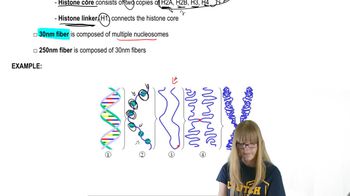
Eukaryotic genes are composed of exons (coding regions) and introns (non-coding regions), along with 5' and 3' flanking sequences that regulate gene expression. Introns are spliced out during mRNA processing, so variations in these regions often do not affect the protein sequence directly. Understanding this structure helps explain why mutations may occur outside exons without altering gene function.
Recommended video:
Guided course
Chromosome Structure
Types of Genetic Variation
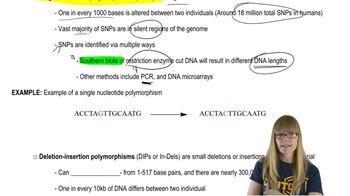
Genetic variation includes nucleotide substitutions, insertions, and deletions. Variations in non-coding regions, such as introns or flanking sequences, can influence gene regulation or splicing but often do not change the amino acid sequence. Recognizing different mutation types clarifies why observed differences might not impact the protein but still contribute to overall genetic diversity.
Recommended video:
Guided course
Genomic Variation
Neutral Theory of Molecular Evolution
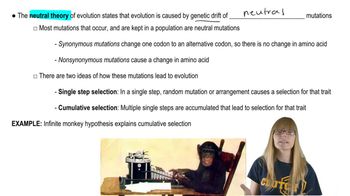
This theory proposes that most genetic variation at the molecular level is selectively neutral, especially in non-coding regions, and accumulates through genetic drift rather than natural selection. Variations outside exons often do not affect fitness, explaining why mutations are more common there. This perspective broadens our understanding of genetic variation beyond just changes that alter protein function.
Recommended video:
Guided course
Evolution
Related Videos
Related Practice
Textbook Question
555
views
