
Textbook Question
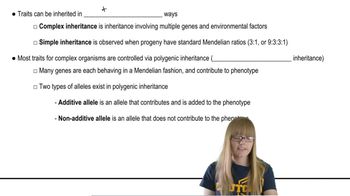
Write a short essay that discusses the difference between the more traditional Mendelian and neo-Mendelian modes of inheritance (qualitative inheritance) and quantitative inheritance.
448
views

 Verified step by step guidance
 04:37
04:37
 13:40
13:40 13:04
13:04Write a short essay that discusses the difference between the more traditional Mendelian and neo-Mendelian modes of inheritance (qualitative inheritance) and quantitative inheritance.
Define the following:
(a) Polygenic
(b) Additive alleles
(c) Correlation
(d) Monozygotic and dizygotic twins
(e) Heritability
(f) QTL
(g) Continuous variation
A dark-red strain and a white strain of wheat are crossed and produce an intermediate, medium-red F₁. When the F₁ plants are interbred, an F₂ generation is produced in a ratio of 1 dark-red: 4 medium-dark-red: 6 medium-red: 4 light-red: 1 white. Further crosses reveal that the dark-red and white F₂ plants are true breeding
Predict the outcome of the F1 and F2 generations in a cross between a true-breeding medium-red plant and a white plant.
A dark-red strain and a white strain of wheat are crossed and produce an intermediate, medium-red F₁. When the F₁ plants are interbred, an F₂ generation is produced in a ratio of 1 dark-red: 4 medium-dark-red: 6 medium-red: 4 light-red: 1 white. Further crosses reveal that the dark-red and white F₂ plants are true breeding
Assign symbols to these alleles, and list possible genotypes that give rise to the medium-red and light-red phenotypes.
A dark-red strain and a white strain of wheat are crossed and produce an intermediate, medium-red F₁. When the F₁ plants are interbred, an F₂ generation is produced in a ratio of 1 dark-red: 4 medium-dark-red: 6 medium-red: 4 light-red: 1 white. Further crosses reveal that the dark-red and white F₂ plants are true breeding
Based on the ratios in the F₂ population, how many genes are involved in the production of color?
Height in humans depends on the additive action of genes. Assume that this trait is controlled by the four loci R, S, T, and U and that environmental effects are negligible. Instead of additive versus nonadditive alleles, assume that additive and partially additive alleles exist. Additive alleles contribute two units, and partially additive alleles contribute one unit to height.
Can two individuals of moderate height produce offspring that are much taller or shorter than either parent? If so, how?