What findings led geneticists to postulate the multiple-factor hypothesis that invoked the idea of additive alleles to explain inheritance patterns?
Verified step by step guidance
1
Understand the historical context: Early geneticists observed that some traits did not follow simple Mendelian inheritance patterns, such as traits showing continuous variation (e.g., height, skin color) rather than discrete categories.
Recognize the key observation: These continuously varying traits suggested that multiple genes, rather than a single gene, influenced the phenotype, leading to the idea that many factors contribute to the trait.
Examine the experimental evidence: Geneticists noticed that when multiple genes affect a trait, their effects can add up in an additive manner, producing a range of phenotypes rather than just a few distinct classes.
Connect the concept of additive alleles: The multiple-factor hypothesis proposed that each gene involved contributes a small, additive effect to the overall phenotype, explaining the continuous distribution of traits.
Summarize the conclusion: The combination of continuous variation, the involvement of multiple genes, and the additive effects of alleles led to the formulation of the multiple-factor hypothesis to explain complex inheritance patterns.
Verified video answer for a similar problem:
This video solution was recommended by our tutors as helpful for the problem above
Video duration:
2m
Play a video:
Was this helpful?
Key Concepts
Here are the essential concepts you must grasp in order to answer the question correctly.
Multiple-Factor Hypothesis
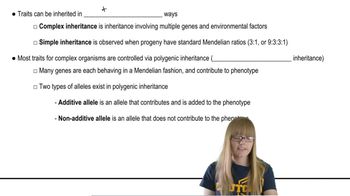
The multiple-factor hypothesis proposes that traits are influenced by several genes, each contributing a small additive effect. This contrasts with single-gene inheritance and helps explain continuous variation in traits like height or skin color.
Additive alleles are gene variants whose effects sum up to influence a trait quantitatively. Each allele adds a certain amount to the phenotype, leading to a range of possible trait values rather than discrete categories.
Continuous variation refers to traits that show a range of phenotypes rather than distinct classes, often influenced by multiple genes and environmental factors. Observations of such traits led geneticists to seek explanations beyond Mendelian single-gene models.