What are the differences between a synonymous mutation, a missense mutation, and a nonsense mutation?
Table of contents
- 1. Introduction to Genetics51m
- 2. Mendel's Laws of Inheritance3h 37m
- 3. Extensions to Mendelian Inheritance2h 41m
- 4. Genetic Mapping and Linkage2h 28m
- 5. Genetics of Bacteria and Viruses1h 21m
- 6. Chromosomal Variation1h 48m
- 7. DNA and Chromosome Structure56m
- 8. DNA Replication1h 10m
- 9. Mitosis and Meiosis1h 34m
- 10. Transcription1h 0m
- 11. Translation58m
- 12. Gene Regulation in Prokaryotes1h 19m
- 13. Gene Regulation in Eukaryotes44m
- 14. Genetic Control of Development44m
- 15. Genomes and Genomics1h 50m
- 16. Transposable Elements47m
- 17. Mutation, Repair, and Recombination1h 6m
- 18. Molecular Genetic Tools19m
- 19. Cancer Genetics29m
- 20. Quantitative Genetics1h 26m
- 21. Population Genetics50m
- 22. Evolutionary Genetics29m
17. Mutation, Repair, and Recombination
Types of Mutations
Problem 7
Textbook Question
Most mutations in a diploid organism are recessive. Why?
Verified step by step guidance1
Understand the concept of diploidy: In diploid organisms, each gene exists in two copies (alleles), one inherited from each parent.
Recall that a recessive mutation typically results in a loss of function or reduced function of the gene product, which means the mutated allele does not produce a functional protein.
Recognize that if one allele is mutated (recessive) and the other allele is normal (wild-type), the normal allele often produces enough functional protein to mask the effect of the mutated allele.
This masking effect means the organism shows the normal phenotype despite carrying the mutation, so the mutation is recessive because its effect is hidden in the presence of a normal allele.
Conclude that most mutations are recessive because loss-of-function mutations usually do not affect the phenotype unless both alleles are mutated, which is less common.
Verified video answer for a similar problem:This video solution was recommended by our tutors as helpful for the problem above
Video duration:
28sPlay a video:
Was this helpful?
Key Concepts
Here are the essential concepts you must grasp in order to answer the question correctly.
Diploidy and Allelic Pairs
Diploid organisms have two copies of each gene, called alleles. This means that if one allele carries a mutation, the other normal allele can often compensate, masking the effect of the mutation in the organism's phenotype.
Recommended video:
Guided course
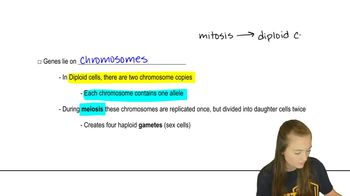
Diploid Genetics
Recessive vs. Dominant Mutations
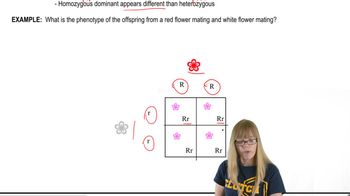
A recessive mutation only affects the phenotype when both alleles are mutated, while a dominant mutation shows its effect even if only one allele is mutated. Most mutations are recessive because the normal allele usually produces enough functional protein to maintain normal function.
Recommended video:
Guided course
Variations on Dominance
Gene Function and Protein Production
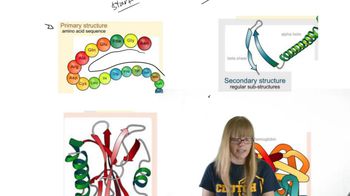
Many mutations reduce or eliminate the function of a gene product, but as long as one allele produces sufficient functional protein, the organism remains unaffected. This functional redundancy explains why most mutations are recessive in diploid organisms.
Recommended video:
Guided course
Proteins
Related Videos
Related Practice
Textbook Question
884
views