
An experienced goldfish breeder receives two unusual male goldfish. One is black rather than gold, and the other has a single tail fin rather than a split tail fin. The breeder crosses the black male to a female that is gold. All the F₁ are gold. She also crosses the single-finned male to a female with a split tail fin. All the F₁ have a split tail fin. She then crosses the black male to F₁ gold females and, separately, crosses the single-finned male to F₁ split-finned females. The results of the crosses are shown below. Black male x F₁ gold female: Gold 32 Black 34 Single-finned male x F₁ split-finned female: Split fin 41 Single fin 39 Use chi-square analysis to test your hereditary hypothesis for each trait.
Verified step by step guidance
1
Step 1: Formulate a hypothesis for each trait. For the color trait, hypothesize that gold (G) is dominant to black (g). For the tail fin trait, hypothesize that split fin (S) is dominant to single fin (s).
Step 2: Determine the expected phenotypic ratios based on the hypothesis. For the black male x F₁ gold female cross, if the F₁ gold females are heterozygous (Gg), the expected ratio is 1 gold (G_) : 1 black (gg). For the single-finned male x F₁ split-finned female cross, if the F₁ split-finned females are heterozygous (Ss), the expected ratio is 1 split fin (S_) : 1 single fin (ss).
Step 3: Calculate the expected numbers for each phenotype based on the total observed offspring. For the black male x F₁ gold female cross, the total offspring is 32 + 34 = 66. The expected numbers are 33 gold and 33 black. For the single-finned male x F₁ split-finned female cross, the total offspring is 41 + 39 = 80. The expected numbers are 40 split fin and 40 single fin.
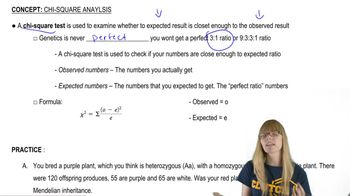
Step 4: Use the chi-square formula to calculate the chi-square value for each trait. The formula is χ² = Σ((O - E)² / E), where O is the observed number and E is the expected number. Perform this calculation separately for the color trait and the tail fin trait.
Step 5: Compare the calculated chi-square values to the critical value from the chi-square distribution table at 1 degree of freedom (df = number of phenotypic categories - 1) and a significance level of 0.05. If the chi-square value is less than the critical value, the hypothesis is supported. If it is greater, the hypothesis is rejected.
Verified video answer for a similar problem:
This video solution was recommended by our tutors as helpful for the problem above
Video duration:
6m
Play a video:
Was this helpful?
Key Concepts
Here are the essential concepts you must grasp in order to answer the question correctly.
Mendelian Inheritance
Mendelian inheritance refers to the principles of heredity established by Gregor Mendel, which include the concepts of dominant and recessive traits. In this scenario, the gold color in goldfish is likely a dominant trait, while the black color is recessive. Understanding these principles is crucial for predicting the outcomes of genetic crosses and interpreting the results of the F₁ generation.
Chi-square analysis is a statistical method used to determine if there is a significant difference between observed and expected frequencies in genetic crosses. This analysis helps assess whether the inheritance patterns observed in the offspring align with Mendelian ratios, allowing breeders to test their hypotheses about trait inheritance effectively.
Phenotypic ratios represent the relative frequencies of different observable traits in the offspring resulting from genetic crosses. In this case, the ratios of gold to black fish and split to single fins can be calculated from the offspring counts. Analyzing these ratios is essential for understanding the inheritance patterns and confirming whether they follow expected Mendelian ratios.