Ch 28: Fundamentals of Circuits
Knight Calc - Physics for Scientists and Engineers 5th Edition
Knight Calc5th EditionPhysics for Scientists and EngineersISBN: 9780137344796Not the one you use?Change textbook
Chapter 28, Problem 64b

A 12 V car battery dies not so much because its voltage drops but because chemical reactions increase its internal resistance. A good battery connected with jumper cables can both start the engine and recharge the dead battery. Consider the automotive circuit of FIGURE P28.64. How much current is the dead battery alone able to drive through the starter motor?
Schematic diagram of a circuit with a good battery, dead battery, and starter motor, showing resistances and voltages.

Verified step by step guidance
1
Identify the key components of the problem: The dead battery has an internal resistance (r_dead) and an electromotive force (emf_dead = 12 V). The starter motor has a resistance (R_motor). The goal is to calculate the current (I_dead) driven by the dead battery through the starter motor.
Apply Ohm's Law to the circuit formed by the dead battery and the starter motor. The total resistance in this circuit is the sum of the internal resistance of the dead battery (r_dead) and the resistance of the starter motor (R_motor). The total resistance is given by: Rtotal=rdead+Rmotor.
The current driven by the dead battery can be calculated using Ohm's Law: Idead=emfdeadRtotal. Substitute the values of emfdead, rdead, and Rmotor into this equation.
Simplify the equation to find the value of Idead. Ensure that the units are consistent (e.g., resistance in ohms, voltage in volts).
Interpret the result: The calculated current Idead represents the amount of current the dead battery alone can drive through the starter motor. This value will likely be small due to the increased internal resistance of the dead battery.

Verified video answer for a similar problem:

This video solution was recommended by our tutors as helpful for the problem above.
Video duration:
15m
Was this helpful?

Key Concepts

Here are the essential concepts you must grasp in order to answer the question correctly.

Ohm's Law

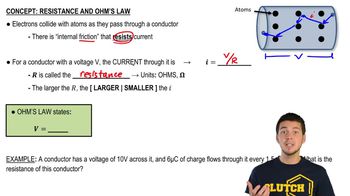
Ohm's Law states that the current (I) flowing through a conductor between two points is directly proportional to the voltage (V) across the two points and inversely proportional to the resistance (R) of the conductor. This relationship is expressed mathematically as I = V/R. Understanding this law is crucial for analyzing how much current a battery can provide, especially when considering the internal resistance of the battery.
Recommended video:
Guided course
03:07
Resistance and Ohm's Law

Internal Resistance

Internal resistance refers to the opposition to current flow within a battery itself, caused by the chemical processes occurring during discharge. As a battery discharges, its internal resistance can increase, reducing the effective voltage available to drive current through an external circuit. This concept is essential for determining how much current a dead battery can supply to a starter motor, as higher internal resistance leads to lower current output.
Recommended video:
Guided course
04:54
Total Internal Energy

Battery Capacity and State of Charge

Battery capacity is a measure of the total charge a battery can store, typically expressed in ampere-hours (Ah). The state of charge indicates how much of that capacity is currently available for use. A dead battery may have a low state of charge, affecting its ability to deliver current. Understanding these concepts helps in evaluating the performance of a battery in starting an engine and the implications of its chemical reactions on current output.
Recommended video:
Guided course
06:36
Charging Objects
Related Practice
Textbook Question

What are the battery current Ibat and the potential difference V₁ - V₂ between points 1 and 2 when the switch in FIGURE P28.55 is (a) open and (b) closed?

170
views

Textbook Question

The capacitor in an RC circuit is discharged with a time constant of 10 ms. At what time after the discharge begins are (a) the charge on the capacitor reduced to half its initial value and (b) the energy stored in the capacitor reduced to half its initial value?

150
views
Textbook Question

What is the current through the 10 Ω resistor in FIGURE P28.61? Is the current from left to right or right to left?

232
views
Textbook Question

How much current flows through the bottom wire in FIGURE P28.66, and in which direction?

204
views
Textbook Question

A circuit you're building needs an ammeter that goes from 0 mA to a full-scale reading of 50 mA. Unfortunately, the only ammeter in the storeroom goes from 0 μA to a full-scale reading of only 500 μA. Fortunately, you've just finished a physics class, and you realize that you can make this ammeter work by putting a resistor in parallel with it, as shown in FIGURE P28.56. You've measured that the resistance of the ammeter is 50.0 Ω, not the 0 Ω of an ideal ammeter. What is the effective resistance of your ammeter?

63
views
Textbook Question

A circuit you’re using discharges a 20 μF capacitor through an unknown resistor. After charging the capacitor, you close a switch at t = 0 s and then monitor the resistor current with an ammeter. Your data are as follows: Use an appropriate graph of the data to determine (a) the resistance and (b) the initial capacitor voltage.

72
views