Ch 24: Gauss' Law
Knight Calc - Physics for Scientists and Engineers 5th Edition
Knight Calc5th EditionPhysics for Scientists and EngineersISBN: 9780137344796Not the one you use?Change textbook
Chapter 24, Problem 41

An infinitely wide, horizontal metal plate lies above a horizontal infinite sheet of charge with surface charge density 800 nC/m2. The bottom surface of the plate has surface charge density -100 nC/m2. What is the surface charge density on the top surface of the plate?

Verified step by step guidance
1
Understand the problem: The system consists of an infinite conducting plate and an infinite sheet of charge. The conducting plate has a surface charge density of -100 nC/m² on its bottom surface, and we need to determine the surface charge density on its top surface. The infinite sheet of charge has a surface charge density of 800 nC/m². Use the principle of electrostatics and Gauss's law to solve this problem.
Step 1: Recall that for a conductor in electrostatic equilibrium, the electric field inside the conductor must be zero. This means the net electric field due to all charges (from the sheet of charge and the plate itself) must cancel out inside the conducting plate.
Step 2: Use Gauss's law to calculate the electric field produced by the infinite sheet of charge. The electric field due to an infinite sheet of charge with surface charge density \( \sigma \) is given by \( E = \frac{\sigma}{2\varepsilon_0} \), where \( \varepsilon_0 \) is the permittivity of free space.
Step 3: Recognize that the conducting plate will redistribute its charges such that the electric field inside it is zero. The charges on the top and bottom surfaces of the plate will create electric fields that counteract the field from the infinite sheet of charge. Let \( \sigma_t \) represent the surface charge density on the top surface of the plate. The total electric field just outside the top surface of the plate must equal the field due to the sheet of charge plus the field due to the plate's charges.
Step 4: Write the equation for the electric field just outside the top surface of the plate: \( E_{top} = \frac{\sigma_t}{\varepsilon_0} - \frac{\sigma_{sheet}}{2\varepsilon_0} = 0 \). Solve for \( \sigma_t \) to find the surface charge density on the top surface of the plate. Substitute \( \sigma_{sheet} = 800 \text{ nC/m}^2 \) and simplify the expression.

Verified video answer for a similar problem:

This video solution was recommended by our tutors as helpful for the problem above.
Video duration:
8m
Was this helpful?

Key Concepts

Here are the essential concepts you must grasp in order to answer the question correctly.

Surface Charge Density

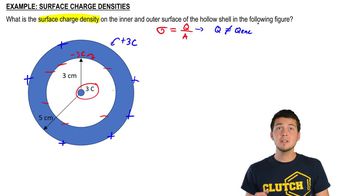
Surface charge density is defined as the amount of electric charge per unit area on a surface. It is typically measured in coulombs per square meter (C/m²) and is crucial for understanding electric fields generated by charged surfaces. In this problem, the surface charge densities of both the infinite sheet and the metal plate are key to determining the resultant electric field and the charge distribution.
Recommended video:
Guided course
04:03
Surface Charge Density

Electric Field Due to a Charged Plane

An infinite plane sheet of charge creates a uniform electric field that is perpendicular to its surface. The magnitude of the electric field (E) produced by a sheet with surface charge density (σ) is given by E = σ/(2ε₀), where ε₀ is the permittivity of free space. This concept is essential for analyzing how the electric fields from the charged sheet and the plate interact and influence the charge distribution on the plate.
Recommended video:
Guided course
06:28
Electric Field due to a Point Charge

Superposition Principle

The superposition principle states that the total electric field created by multiple charge distributions is the vector sum of the electric fields produced by each distribution individually. In this scenario, the electric fields from the infinite sheet of charge and the charged plate must be combined to find the net effect on the top surface of the plate, which ultimately determines its surface charge density.
Recommended video:
Guided course
03:32
Superposition of Sinusoidal Wave Functions
Related Practice
Textbook Question

The three parallel planes of charge shown in FIGURE P24.44 have surface charge densities ─ ½ η , η , and ─ ½ η. Find the electric fields EA\(\overrightarrow{E_{A}\)} to ED\(\overrightarrow{E_{D}\)} in regions A to D. The upward direction is the + y-direction.

2230
views

Textbook Question

FIGURE P24.46 shows an infinitely wide conductor parallel to and distance d from an infinitely wide plane of charge with surface charge density η. What are the electric fields EA\(\overrightarrow{E_{A}\)} to ED\(\overrightarrow{E_{D}\)} in regions A to D?

200
views
Textbook Question

Figure 24.32b showed a conducting box inside a parallel-plate capacitor. The electric field inside the box is E=0\(\overrightarrow{E}\)=\(\overrightarrow{0}\). Suppose the surface charge on the exterior of the box could be frozen. Draw a picture of the electric field inside the box after the box, with its frozen charge, is removed from the capacitor. Hint: Superposition.

1332
views
Textbook Question

An infinite slab of charge of thickness 2𝒵₀ lies in the xy-plane between 𝒵 = -𝒵₀ and 𝒵 = +𝒵₀ . The volume charge density p (C/m3) is a constant. Find an expression for the electric field strength above the slab (𝒵 ≥ 𝒵₀).

2512
views
Textbook Question

The earth has a vertical electric field at the surface, pointing down, that averages 100 N/C. This field is maintained by various atmospheric processes, including lightning. What is the excess charge on the surface of the earth?

2190
views
Textbook Question

A 20-cm-radius ball is uniformly charged to 80 nC. How much charge is enclosed by spheres of radii 5, 10, and 20 cm?

1831
views