Ch 12: Rotation of a Rigid Body
Knight Calc - Physics for Scientists and Engineers 5th Edition
Knight Calc5th EditionPhysics for Scientists and EngineersISBN: 9780137344796Not the one you use?Change textbook
Chapter 12, Problem 47

A 75 g, 6.0-cm-diameter solid spherical top is spun at 1200 rpm on an axle that extends 1.0 cm past the edge of the sphere. The tip of the axle is placed on a support. What is the top's precession frequency in rpm?

Verified step by step guidance
1
Step 1: Identify the key quantities given in the problem. The mass of the sphere is 75 g (convert to kg: 0.075 kg), the diameter is 6.0 cm (convert to radius: 0.03 m), the axle extends 1.0 cm past the edge of the sphere, and the spinning frequency is 1200 rpm. The goal is to find the precession frequency in rpm.
Step 2: Calculate the moment of inertia of the solid sphere about its axis of rotation. For a solid sphere, the moment of inertia is given by \( I = \frac{2}{5} m r^2 \), where \( m \) is the mass and \( r \) is the radius. Substitute the values of \( m \) and \( r \) into the formula.
Step 3: Determine the angular velocity of the spinning top. Convert the spinning frequency from rpm to radians per second using the formula \( \omega = \text{frequency} \times \frac{2\pi}{60} \). This gives the angular velocity in radians per second.
Step 4: Calculate the torque due to gravity acting on the sphere. The torque is given by \( \tau = m g d \), where \( m \) is the mass, \( g \) is the acceleration due to gravity (approximately 9.8 m/s²), and \( d \) is the distance from the center of the sphere to the point of support (radius + axle extension). Substitute the values into the formula.
Step 5: Use the relationship between precession frequency and torque to find the precession frequency. The precession angular velocity \( \Omega \) is given by \( \Omega = \frac{\tau}{I \omega} \). Convert \( \Omega \) from radians per second to rpm using \( \Omega_{\text{rpm}} = \Omega \times \frac{60}{2\pi} \). This gives the precession frequency in rpm.

Verified video answer for a similar problem:

This video solution was recommended by our tutors as helpful for the problem above.
Was this helpful?

Key Concepts

Here are the essential concepts you must grasp in order to answer the question correctly.

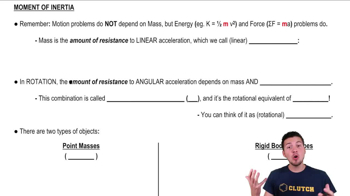
Moment of Inertia

The moment of inertia is a measure of an object's resistance to changes in its rotational motion. For a solid sphere, it is calculated using the formula I = (2/5) * m * r^2, where m is the mass and r is the radius. This concept is crucial for understanding how the mass distribution affects the top's rotational dynamics.
Recommended video:
Guided course
11:47
Intro to Moment of Inertia

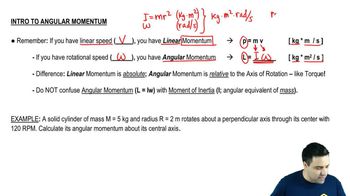
Angular Momentum

Angular momentum is the rotational equivalent of linear momentum and is given by the product of the moment of inertia and the angular velocity (L = I * ω). It is a conserved quantity in a closed system, meaning that the total angular momentum remains constant unless acted upon by an external torque. This principle is essential for analyzing the motion of the spinning top.
Recommended video:
Guided course
06:18
Intro to Angular Momentum

Precession

Precession is the phenomenon where the axis of a spinning object moves in a circular path due to an external torque, such as gravity acting on a tilted spinning top. The precession frequency can be calculated using the relationship between angular momentum and torque. Understanding precession is key to determining how the top behaves when it is spun and supported at an angle.