Ch 10: Interactions and Potential Energy
Knight Calc - Physics for Scientists and Engineers 5th Edition
Knight Calc5th EditionPhysics for Scientists and EngineersISBN: 9780137344796Not the one you use?Change textbook
Chapter 10, Problem 31

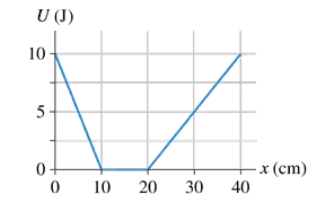
A system in which only one particle moves has the potential energy shown in FIGURE EX10.31. What is the x-component of the force on the particle at x = 5, 15, and 25 cm?

Verified step by step guidance
1
Step 1: Recall the relationship between force and potential energy. The force acting on a particle is given by the negative gradient of the potential energy function: F_x = -dU/dx.
Step 2: Analyze the graph of potential energy (U) versus position (x). The graph shows linear segments where the slope of U changes. Identify the slope of U in the regions of interest: x = 5 cm, x = 15 cm, and x = 25 cm.
Step 3: For x = 5 cm, observe that this point lies in the region where U is increasing linearly from 0 to 10 J between x = 0 cm and x = 4 cm. Calculate the slope of this segment using the formula: slope = (change in U) / (change in x).
Step 4: For x = 15 cm, note that this point lies outside the range of the graph provided (x = 0 cm to x = 10 cm). Since the graph does not extend to x = 15 cm, the force at this position cannot be determined from the given data.
Step 5: For x = 25 cm, similarly, this point lies outside the range of the graph provided. The force at this position cannot be determined from the given data.

Verified video answer for a similar problem:

This video solution was recommended by our tutors as helpful for the problem above.
Video duration:
7m
Was this helpful?

Key Concepts

Here are the essential concepts you must grasp in order to answer the question correctly.

Potential Energy (U)

Potential energy is the energy stored in a system due to the position of an object within a force field, such as gravitational or elastic fields. In the context of the given graph, potential energy is plotted against position, indicating how the energy changes as the particle moves. The shape of the graph reveals regions of stable and unstable equilibrium, which are crucial for understanding the forces acting on the particle.
Recommended video:
Guided course
06:35
Gravitational Potential Energy

Force and Potential Energy Relationship

The force acting on a particle can be derived from the potential energy function using the relationship F = -dU/dx, where F is the force and U is the potential energy. This means that the force is equal to the negative gradient of the potential energy with respect to position. By analyzing the slope of the potential energy graph at specific positions, one can determine the x-component of the force acting on the particle.
Recommended video:
Guided course
03:43
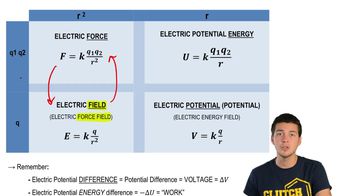
Relationships Between Force, Field, Energy, Potential

Equilibrium Points

Equilibrium points occur where the net force acting on a particle is zero, which corresponds to the local maxima or minima of the potential energy graph. At these points, the particle experiences no net force and can be in stable (minimum) or unstable (maximum) equilibrium. Understanding these points is essential for predicting the behavior of the particle as it moves through different positions along the x-axis.
Recommended video:
Guided course
10:13
Torque & Equilibrium