
Ch. 05 - Using Newton's Laws: Friction, Circular Motion, Drag Forces
Giancoli Douglas - Physics for Scientists and Engineers 5th edition
Giancoli Douglas5th editionPhysics for Scientists and EngineersISBN: 9780137488179Not the one you use?Change textbook
Chapter 5, Problem 29a

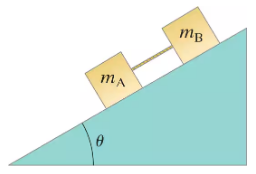
Two blocks made of different materials connected together by a thin cord slide down a ramp inclined at an angle θ to the horizontal, Fig. 5–40 (block B is above block A). The masses of the blocks are mA and mB, and the coefficients of friction are μA and μB. If mA = mB=4.0kg, and μA = 0.20 and μB = 0.30, determine the acceleration of the blocks.
Two blocks, mA and mB, connected by a cord, slide down an inclined plane at angle θ, illustrating friction effects.

Verified step by step guidance
1
Identify the forces acting on each block. For both blocks, the forces include gravity (m_A * g and m_B * g), the normal force perpendicular to the ramp, and the frictional force opposing motion. The frictional force is given by f_A = μ_A * N_A and f_B = μ_B * N_B, where N_A and N_B are the normal forces for blocks A and B, respectively.
Resolve the gravitational force into components parallel and perpendicular to the incline. The parallel component is m * g * sin(θ), and the perpendicular component is m * g * cos(θ). These components will help determine the net force acting along the incline.
Write the equations of motion for the system. The net force acting on the system is the sum of the forces parallel to the incline minus the frictional forces. This can be expressed as: F_net = (m_A + m_B) * g * sin(θ) - (f_A + f_B).
Substitute the expressions for the frictional forces into the equation. Since f_A = μ_A * m_A * g * cos(θ) and f_B = μ_B * m_B * g * cos(θ), the net force becomes: F_net = (m_A + m_B) * g * sin(θ) - (μ_A * m_A * g * cos(θ) + μ_B * m_B * g * cos(θ)).
Use Newton's second law to find the acceleration of the system. The acceleration is given by a = F_net / (m_A + m_B). Substitute the expression for F_net into this formula to calculate the acceleration of the blocks down the incline.

Verified video answer for a similar problem:

This video solution was recommended by our tutors as helpful for the problem above.
Video duration:
9m
Was this helpful?

Key Concepts

Here are the essential concepts you must grasp in order to answer the question correctly.

Newton's Second Law of Motion

Newton's Second Law states that the acceleration of an object is directly proportional to the net force acting on it and inversely proportional to its mass. This principle is essential for analyzing the motion of the blocks on the ramp, as it allows us to calculate the resultant force by considering both gravitational and frictional forces acting on each block.
Recommended video:
Guided course
06:54
Intro to Forces & Newton's Second Law

Frictional Force

Frictional force is the resistance that one surface or object encounters when moving over another. It is calculated using the coefficient of friction and the normal force. In this scenario, the different coefficients of friction for blocks A and B will affect their acceleration down the ramp, making it crucial to account for these forces in the calculations.
Recommended video:
Guided course
08:11
Static Friction & Equilibrium

Inclined Plane Dynamics

The dynamics of objects on an inclined plane involve analyzing forces acting parallel and perpendicular to the surface. The gravitational force can be resolved into components, with one acting down the ramp and the other acting perpendicular to it. Understanding these components is vital for determining the net force and, consequently, the acceleration of the blocks as they slide down the ramp.
Recommended video:
Guided course
06:59
Intro to Inclined Planes
Related Practice
Textbook Question

(III) A 4.0-kg block is stacked on top of a 12.0-kg block, which is accelerating along a horizontal table at a = 5.2m/s2 (Fig. 5–43). Let μk = μs = μ. What is the force that must be applied to the 12.0-kg block in (a) and in (b), assuming that the table is frictionless?

1493
views
Textbook Question

A jet plane traveling 1890 km/h (525 m/s) pulls out of a dive by moving in an arc of radius 4.80 km. What is the plane's acceleration in g's?

1570
views
Textbook Question

Piles of snow on slippery roofs can become dangerous projectiles as they melt. Consider a chunk of snow at the ridge of a roof with a slope of 24°. As the snow begins to melt, the coefficient of static friction decreases and the snow finally slips. Assuming that the distance from a chunk of snow to the edge of the roof is 6.0 m and the coefficient of kinetic friction is 0.20, calculate the speed of the snow chunk when it slides off the roof.

818
views
Textbook Question

A flatbed truck is carrying a heavy crate. The coefficient of static friction between the crate and the bed of the truck is 0.75. What is the maximum rate at which the driver can decelerate and still avoid having the crate slide against the cab of the truck?

1445
views
Textbook Question

Two blocks made of different materials connected together by a thin cord slide down a ramp inclined at an angle θ to the horizontal, Fig. 5–40 (block B is above block A). The masses of the blocks are mA and mB, and the coefficients of friction are μA and μB. If mA = mB = 4.0kg, and μA = 0.20 and μB = 0.30, determine the tension in the cord, for an angle θ = 32°.

566
views
Textbook Question

Police investigators, examining the scene of an accident involving a car and an old truck, measure 72-m-long skid marks for the truck, which nearly came to a stop before colliding with the car at rest. The coefficient of kinetic friction between rubber and the pavement is about 0.80. Estimate the initial speed of the truck assuming a level road.

1142
views