Ch 05: Force and Motion
Knight Calc - Physics for Scientists and Engineers 5th Edition
Knight Calc5th EditionPhysics for Scientists and EngineersISBN: 9780137344796Not the one you use?Change textbook
Chapter 5, Problem 57b

If a car stops suddenly, you feel 'thrown forward.' We'd like to understand what happens to the passengers as a car stops. Imagine yourself sitting on a very slippery bench inside a car. This bench has no friction, no seat back, and there's nothing for you to hold onto. Draw your free-body diagram. Is there a net force on you? If so, in which direction?

Verified step by step guidance
1
Start by understanding the scenario: When the car stops suddenly, the passengers inside the car experience inertia, which is the tendency of an object to resist changes in its state of motion. This is described by Newton's First Law of Motion.
Draw the free-body diagram for the passenger. Since the bench is frictionless, there are no horizontal forces acting on the passenger. The only forces acting are vertical: the gravitational force (weight) acting downward, represented as \( F_g = m \cdot g \), and the normal force exerted by the bench acting upward, represented as \( F_N \). These two forces are equal in magnitude and opposite in direction, so they cancel each other out.
Analyze the horizontal motion: When the car stops, the passenger continues moving forward due to inertia. There is no net horizontal force acting on the passenger because the bench is frictionless and there is no external force applied to stop the passenger's motion.
Conclude whether there is a net force: In the vertical direction, the forces (gravitational force and normal force) cancel out, resulting in no net vertical force. In the horizontal direction, there is no force acting on the passenger to oppose their forward motion, so there is no net horizontal force either. The passenger's forward motion is due to their inertia, not a net force.
Summarize the situation: The sensation of being 'thrown forward' is not due to a force acting on the passenger but rather the lack of a force to stop their forward motion. This is a direct consequence of Newton's First Law of Motion, which states that an object in motion will remain in motion unless acted upon by an external force.

Verified video answer for a similar problem:

This video solution was recommended by our tutors as helpful for the problem above.
Was this helpful?

Key Concepts

Here are the essential concepts you must grasp in order to answer the question correctly.

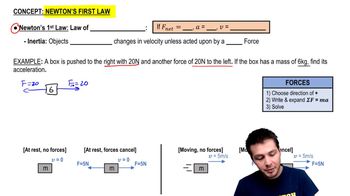
Newton's First Law of Motion

Newton's First Law states that an object at rest will remain at rest, and an object in motion will continue in motion with the same speed and in the same direction unless acted upon by a net external force. In the context of the car stopping, the passengers continue moving forward due to their inertia, which is the tendency of an object to resist changes in its state of motion.
Recommended video:
Guided course
04:46
Newton's 1st Law

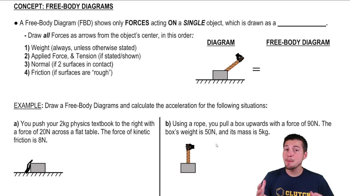
Free-Body Diagram

A free-body diagram is a graphical representation used to visualize the forces acting on an object. In this scenario, the diagram would show the forces acting on the passenger, including gravitational force downward and the inertial force that appears to push them forward when the car stops. This helps in understanding the net force and the resulting motion.
Recommended video:
Guided course
08:42
Free-Body Diagrams

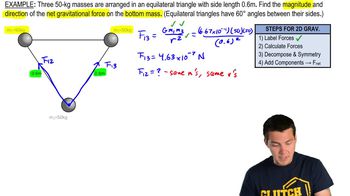
Net Force

Net force is the vector sum of all the forces acting on an object. If the only forces considered are gravity acting downward and the inertial effect pushing the passenger forward, the net force on the passenger is directed forward relative to the car. This indicates that while the car decelerates, the passenger experiences a sensation of being thrown forward due to the lack of a restraining force.
Recommended video:
Guided course
06:28
Finding Net Forces in 2D Gravitation