Ch 05: Force and Motion
Knight Calc - Physics for Scientists and Engineers 5th Edition
Knight Calc5th EditionPhysics for Scientists and EngineersISBN: 9780137344796Not the one you use?Change textbook
Chapter 5, Problem 25

Exercises 23, 24, 25, 26, and 27 describe a situation. For each, identify all forces acting on the object and draw a free-body diagram of the object. Your physics textbook is sliding across the table.

Verified step by step guidance
1
Identify the object in question: The object is the physics textbook sliding across the table.
List all forces acting on the object: (1) The gravitational force (weight) acting downward, represented as Fg, (2) The normal force exerted by the table acting upward, represented as Fn, (3) The kinetic friction force opposing the motion of the textbook, represented as Fk.
Draw a free-body diagram: Represent the textbook as a box. Draw an arrow pointing downward from the center of the box to represent the gravitational force Fg. Draw an arrow pointing upward from the center of the box to represent the normal force Fn. Draw an arrow pointing to the left (opposite the direction of motion) to represent the kinetic friction force Fk.
Explain the balance of forces: Since the textbook is sliding across the table, the normal force Fn balances the gravitational force Fg vertically. Horizontally, the kinetic friction force Fk opposes the motion of the textbook.
Conclude the analysis: The forces acting on the textbook are the gravitational force, the normal force, and the kinetic friction force. The free-body diagram visually represents these forces, and their interactions explain the motion of the textbook across the table.

Verified video answer for a similar problem:

This video solution was recommended by our tutors as helpful for the problem above.
Video duration:
2m
Was this helpful?

Key Concepts

Here are the essential concepts you must grasp in order to answer the question correctly.

Free-Body Diagram

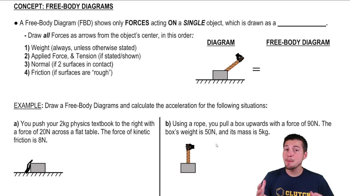
A free-body diagram is a graphical representation used to visualize the forces acting on an object. It typically includes the object in question, represented as a dot or a box, and arrows indicating the direction and magnitude of each force. This tool helps in analyzing the net force and understanding the motion of the object based on Newton's laws.
Recommended video:
Guided course
08:42
Free-Body Diagrams

Types of Forces

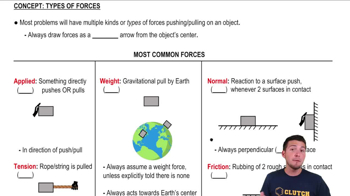
Forces can be categorized into several types, including gravitational, normal, frictional, and applied forces. In the context of a sliding object, gravitational force pulls it downward, while the normal force acts perpendicular to the surface, countering gravity. Frictional force opposes the motion, and any applied force would be the force causing the object to slide.
Recommended video:
Guided course
06:18
Types of Forces

Newton's Laws of Motion

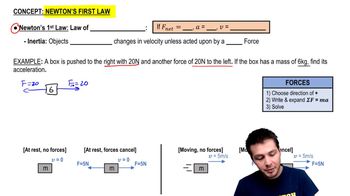
Newton's Laws of Motion describe the relationship between the motion of an object and the forces acting on it. The first law states that an object at rest stays at rest, and an object in motion stays in motion unless acted upon by a net external force. The second law quantifies this relationship, stating that the acceleration of an object is directly proportional to the net force acting on it and inversely proportional to its mass.
Recommended video:
Guided course
04:46
Newton's 1st Law