

Ch. 27 - Magnetism
Giancoli Douglas - Physics for Scientists and Engineers 5th edition
Giancoli Douglas5th editionPhysics for Scientists and EngineersISBN: 9780137488179Not the one you use?Change textbook
Chapter 26, Problem ]11

A stiff wire 50.0 cm long is bent at a right angle in the middle. One section lies along the z axis and the other is along the line y = 2x in the xy plane. A current of 20.0 A flows in the wire—down the z axis and out the wire in the xy plane. The wire passes through a uniform magnetic field given by = (0.285î ) T. Determine the magnitude and direction of the total force on the wire.

Verified step by step guidance
1
Understand the problem: The wire is bent at a right angle, with one segment along the z-axis and the other in the xy-plane along the line y = 2x. A current flows through the wire, and the wire is in a uniform magnetic field. We need to calculate the total magnetic force on the wire using the formula for the magnetic force on a current-carrying conductor: F = I (L × B), where I is the current, L is the length vector of the wire, and B is the magnetic field vector.
Step 1: Analyze the first segment of the wire (along the z-axis). The length vector for this segment is L₁ = -0.25k̂ m (since the wire is 50.0 cm long and the current flows downward along the z-axis). The magnetic field is B = 0.285î T. Use the cross product formula for the force: F₁ = I (L₁ × B).
Step 2: Compute the cross product for the first segment. The cross product L₁ × B involves the vectors L₁ = -0.25k̂ and B = 0.285î. Recall the rule for cross products: k̂ × î = ĵ. Therefore, L₁ × B = (-0.25)(0.285)(ĵ). The force on this segment is F₁ = I (L₁ × B). Substitute I = 20.0 A to find the force vector for this segment.
Step 3: Analyze the second segment of the wire (in the xy-plane along y = 2x). The length vector for this segment can be written as L₂ = (Δxî + Δyĵ), where Δx = 0.25/√5 m and Δy = 2(Δx) = 0.5/√5 m (using the slope y = 2x and the total length of 0.25 m). The magnetic field is still B = 0.285î T. Use the cross product formula for the force: F₂ = I (L₂ × B).
Step 4: Compute the cross product for the second segment. The cross product L₂ × B involves the vectors L₂ = (Δxî + Δyĵ) and B = 0.285î. Since the cross product of any vector with itself is zero (î × î = 0), only the term involving ĵ contributes: L₂ × B = Δy(ĵ × î) = -Δy(0.285k̂). Substitute Δy = 0.5/√5 m and I = 20.0 A to find the force vector for this segment.
Step 5: Add the forces from both segments to find the total force. The total force is F_total = F₁ + F₂. Combine the components of F₁ and F₂ to determine the magnitude and direction of the total force. Use the Pythagorean theorem to calculate the magnitude: |F_total| = √(F_x² + F_y² + F_z²), and use trigonometry to find the direction.

Verified video answer for a similar problem:

This video solution was recommended by our tutors as helpful for the problem above.
Video duration:
9m
Was this helpful?

Key Concepts

Here are the essential concepts you must grasp in order to answer the question correctly.

Magnetic Force on a Current-Carrying Wire

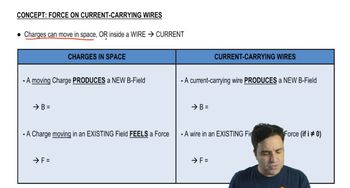
The magnetic force on a current-carrying wire is given by the equation F = I(L × B), where F is the force, I is the current, L is the length vector of the wire in the direction of the current, and B is the magnetic field vector. The direction of the force can be determined using the right-hand rule, which states that if you point your thumb in the direction of the current and your fingers in the direction of the magnetic field, your palm will face the direction of the force.
Recommended video:
Guided course
09:57
Magnetic Force on Current-Carrying Wire

Vector Components

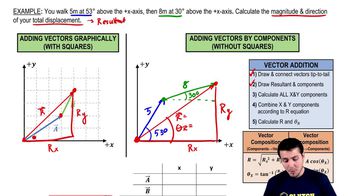
In physics, vectors can be broken down into their components along the coordinate axes. For example, a vector in the xy-plane can be expressed in terms of its x and y components. This is crucial for analyzing forces acting on different segments of the wire, as each segment may experience different magnetic forces based on its orientation relative to the magnetic field.
Recommended video:
Guided course
07:30
Vector Addition By Components

Right-Hand Rule

The right-hand rule is a mnemonic used to determine the direction of the magnetic force, magnetic field, or current in electromagnetic contexts. For a current-carrying wire in a magnetic field, if you align your right hand so that your thumb points in the direction of the current and your fingers point in the direction of the magnetic field, your palm will indicate the direction of the force acting on the wire. This rule is essential for visualizing and calculating the forces in this problem.
Recommended video:
Guided course
19:11
Force on Moving Charges & Right Hand Rule