A disoriented physics professor drives 3.25 km north, then 2.20 km west, and then 1.50 km south. Find the magnitude and direction of the resultant displacement, using the method of components. In a vector-addition diagram (roughly to scale), show that the resultant displacement found from your diagram is in qualitative agreement with the result you obtained by using the method of components.
Verified step by step guidance
1
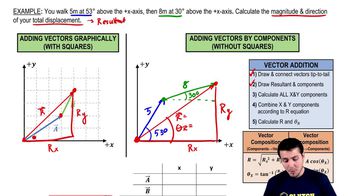
Begin by identifying the vectors involved in the problem. The professor drives 3.25 km north, 2.20 km west, and 1.50 km south. These can be represented as vectors: \( \mathbf{A} = 3.25 \text{ km north} \), \( \mathbf{B} = 2.20 \text{ km west} \), and \( \mathbf{C} = 1.50 \text{ km south} \).
Convert each vector into its components. For vector \( \mathbf{A} \), the north direction corresponds to the positive y-axis, so \( \mathbf{A} = (0, 3.25) \). For vector \( \mathbf{B} \), the west direction corresponds to the negative x-axis, so \( \mathbf{B} = (-2.20, 0) \). For vector \( \mathbf{C} \), the south direction corresponds to the negative y-axis, so \( \mathbf{C} = (0, -1.50) \).
Add the components of the vectors to find the resultant vector \( \mathbf{R} \). The x-component of \( \mathbf{R} \) is the sum of the x-components of \( \mathbf{A} \), \( \mathbf{B} \), and \( \mathbf{C} \): \( R_x = 0 + (-2.20) + 0 = -2.20 \). The y-component of \( \mathbf{R} \) is the sum of the y-components: \( R_y = 3.25 + 0 + (-1.50) = 1.75 \). Thus, \( \mathbf{R} = (-2.20, 1.75) \).
Calculate the magnitude of the resultant displacement vector \( \mathbf{R} \) using the Pythagorean theorem: \( |\mathbf{R}| = \sqrt{R_x^2 + R_y^2} = \sqrt{(-2.20)^2 + (1.75)^2} \).
Determine the direction of the resultant displacement vector \( \mathbf{R} \) by calculating the angle \( \theta \) with respect to the negative x-axis using the tangent function: \( \theta = \tan^{-1}\left(\frac{R_y}{R_x}\right) = \tan^{-1}\left(\frac{1.75}{-2.20}\right) \). This angle will give the direction of the displacement vector relative to the west direction.
Verified video answer for a similar problem:
This video solution was recommended by our tutors as helpful for the problem above
Video duration:
3m
Play a video:
0 Comments
Key Concepts
Here are the essential concepts you must grasp in order to answer the question correctly.
Vector Addition
Vector addition involves combining vectors to find a resultant vector. This is done by adding the components of each vector along the same direction. In this problem, the professor's movements north, west, and south are vectors that need to be added to find the total displacement.
The method of components breaks down vectors into their horizontal and vertical parts, typically using trigonometry. For this problem, the north and south movements affect the vertical component, while the west movement affects the horizontal component. Calculating these components allows for precise vector addition.
Resultant displacement is the single vector that represents the total effect of multiple vectors. It is found by combining the components of each vector and calculating the magnitude and direction. In this scenario, it represents the professor's overall change in position from the starting point.