


Ch 30: Electromagnetic Induction
Knight Calc - Physics for Scientists and Engineers 5th Edition
Knight Calc5th EditionPhysics for Scientists and EngineersISBN: 9780137344796Not the one you use?Change textbook
Chapter 30, Problem 48

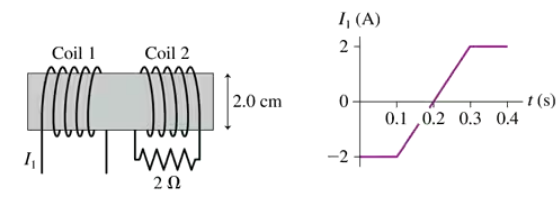
FIGURE P30.48 shows two 20-turn coils tightly wrapped on the same 2.0-cm-diameter cylinder with 1.0-mm-diameter wire. The current through coil 1 is shown in the graph. Determine the current in coil 2 at (a) t = 0.05 s and (b) t = 0.25 s. A positive current is into the figure at the top of a loop. Assume that the magnetic field of coil 1 passes entirely through coil 2.

Verified step by step guidance
1
Step 1: Understand the problem. The two coils are tightly wrapped on the same cylinder, and the current in coil 1 changes over time, as shown in the graph. This changing current generates a changing magnetic field, which induces an electromotive force (EMF) in coil 2 according to Faraday's Law of Induction.
Step 2: Apply Faraday's Law of Induction. Faraday's Law states that the induced EMF in coil 2 is given by \( \text{EMF} = -N \frac{d\Phi_B}{dt} \), where \( N \) is the number of turns in coil 2, and \( \Phi_B \) is the magnetic flux through coil 2. The negative sign indicates the direction of the induced EMF opposes the change in flux.
Step 3: Calculate the magnetic flux \( \Phi_B \). The magnetic flux is given by \( \Phi_B = B \cdot A \), where \( B \) is the magnetic field produced by coil 1, and \( A \) is the cross-sectional area of the cylinder. The magnetic field \( B \) can be calculated using Ampere's Law or the Biot-Savart Law, and depends on the current \( I_1 \) in coil 1.
Step 4: Determine \( \frac{d\Phi_B}{dt} \). The rate of change of magnetic flux \( \frac{d\Phi_B}{dt} \) depends on the rate of change of the current \( \frac{dI_1}{dt} \) in coil 1, as shown in the graph. Use the graph to find \( \frac{dI_1}{dt} \) at \( t = 0.05 \, \text{s} \) and \( t = 0.25 \, \text{s} \). Substitute this into the expression for \( \frac{d\Phi_B}{dt} \).
Step 5: Relate the induced EMF to the current in coil 2. The induced EMF drives a current \( I_2 \) in coil 2, which can be calculated using Ohm's Law: \( I_2 = \frac{\text{EMF}}{R} \), where \( R \) is the resistance of coil 2. The resistance \( R \) can be calculated using the wire's diameter and resistivity. Substitute the values to find \( I_2 \) at \( t = 0.05 \, \text{s} \) and \( t = 0.25 \, \text{s} \).

Verified video answer for a similar problem:

This video solution was recommended by our tutors as helpful for the problem above.
Video duration:
12m
Was this helpful?

Key Concepts

Here are the essential concepts you must grasp in order to answer the question correctly.

Electromagnetic Induction

Electromagnetic induction is the process by which a changing magnetic field within a coil of wire induces an electromotive force (EMF) in that coil. This principle, described by Faraday's Law, states that the induced EMF is proportional to the rate of change of the magnetic flux through the coil. In this scenario, the changing current in coil 1 creates a varying magnetic field that affects coil 2, leading to an induced current.
Recommended video:
Guided course
05:42
Introduction to Induction

Mutual Inductance

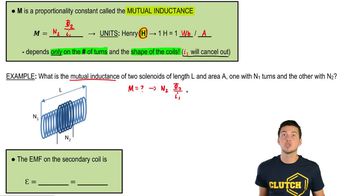
Mutual inductance is a measure of the ability of one coil to induce an EMF in another nearby coil due to a changing current. It depends on the physical arrangement of the coils and the magnetic permeability of the medium between them. The mutual inductance between coil 1 and coil 2 will determine how much current is induced in coil 2 when the current in coil 1 changes over time.
Recommended video:
Guided course
12:59
Mutual Induction

Lenz's Law

Lenz's Law states that the direction of the induced current in a coil will be such that it opposes the change in magnetic flux that produced it. This means that if the current in coil 1 increases, the induced current in coil 2 will flow in a direction that creates a magnetic field opposing the increase. Understanding Lenz's Law is crucial for determining the direction of the induced current in coil 2 at the specified times.
Recommended video:
Related Practice
Textbook Question

A 2.0 cm×2.0 cm square loop of wire with resistance 0.010 Ω has one edge parallel to a long straight wire. The near edge of the loop is 1.0 cm from the wire. The current in the wire is increasing at the rate of 100 A/s. What is the current in the loop?

153
views
Textbook Question

CALC An electric generator has an 18-cm-diameter, 120-turn coil that rotates at 60 Hz in a uniform magnetic field that is perpendicular to the rotation axis. What magnetic field strength is needed to generate a peak voltage of 170 V?

150
views
Textbook Question

A small, 2.0-mm-diameter circular loop with R = 0.020 Ω is at the center of a large 100-mm-diameter circular loop. Both loops lie in the same plane. The current in the outer loop changes from +1.0 A to −1.0 A in 0.10 s. What is the induced current in the inner loop?

69
views
Textbook Question

CALC An 8.0 cm×8.0 cm square loop is halfway into a magnetic field perpendicular to the plane of the loop. The loop's mass is 10 g and its resistance is 0.010 Ω. A switch is closed at t = 0 s, causing the magnetic field to increase from 0 to 1.0 T in 0.010 s. Hint: What is the impulse on the loop? With what speed is the loop 'kicked' away from the magnetic field?

175
views
Textbook Question

FIGURE P30.47 shows a 1.0-cm-diameter loop with R = 0.50 Ω inside a 2.0-cm-diameter solenoid. The solenoid is 8.0 cm long, has 120 turns, and carries the current shown in the graph. A positive current is cw when seen from the left. Determine the current in the loop at t = 0.010 s.

145
views
Textbook Question

A rectangular metal loop with 0.050 Ω resistance is placed next to one wire of the RC circuit shown in FIGURE P30.53. The capacitor is charged to 20 V with the polarity shown, then the switch is closed at t = 0 s. What is the current in the loop at t = 5.0 μs? Assume that only the circuit wire next to the loop is close enough to produce a significant magnetic field.

124
views