Ch 38: Quantization
Knight Calc - Physics for Scientists and Engineers 5th Edition
Knight Calc5th EditionPhysics for Scientists and EngineersISBN: 9780137344796Not the one you use?Change textbook
Chapter 38, Problem 71d

In the atom interferometer experiment of Figure 38.13, laser-cooling techniques were used to cool a dilute vapor of sodium atoms to a temperature of 0.0010 K=1.0 mK. The ultracold atoms passed through a series of collimating apertures to form the atomic beam you see entering the figure from the left. The standing light waves were created from a laser beam with a wavelength of 590 nm. Because interference is observed between the two paths, each individual atom is apparently present at both point B and point C. Describe, in your own words, what this experiment tells you about the nature of matter.

Verified step by step guidance
1
This experiment demonstrates the wave-particle duality of matter, a fundamental concept in quantum mechanics. It shows that particles such as atoms can exhibit wave-like behavior under certain conditions.
The interference observed between the two paths (at points B and C) indicates that each atom behaves as a wave and can exist in a superposition state, meaning it is simultaneously present at both points B and C.
The standing light waves act as a diffraction grating for the atomic beam, splitting the wave-like atoms into different paths. This is analogous to how light waves interfere in a double-slit experiment.
The ability to observe interference patterns confirms that the de Broglie wavelength of the atoms is significant at these ultracold temperatures (0.0010 K), where their thermal motion is minimal, and quantum effects dominate.
This experiment highlights the quantum mechanical principle that matter, at a fundamental level, does not behave like classical particles but instead exhibits probabilistic and wave-like properties.

Verified video answer for a similar problem:

This video solution was recommended by our tutors as helpful for the problem above.
Video duration:
5m
Was this helpful?

Key Concepts

Here are the essential concepts you must grasp in order to answer the question correctly.

Wave-Particle Duality

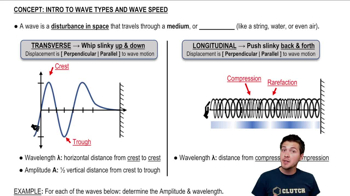
Wave-particle duality is a fundamental concept in quantum mechanics that describes how particles, such as atoms, exhibit both wave-like and particle-like properties. In the context of the atom interferometer experiment, this duality allows individual atoms to interfere with themselves, suggesting that they can exist in multiple states or locations simultaneously, akin to waves. This phenomenon challenges classical intuitions about matter and highlights the complex nature of quantum systems.
Recommended video:
Guided course
07:19
Intro to Waves and Wave Speed

Quantum Superposition

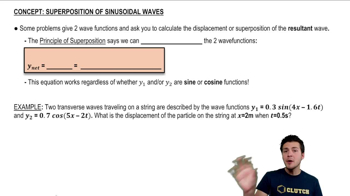
Quantum superposition is the principle that a quantum system can exist in multiple states at once until it is measured. In the atom interferometer experiment, the sodium atoms are in a superposition of paths, meaning they can be thought of as traveling through both paths B and C simultaneously. This concept is crucial for understanding how interference patterns arise in quantum experiments, as the probabilities of different outcomes are determined by the superposition of these states.
Recommended video:
Guided course
03:32
Superposition of Sinusoidal Wave Functions

Interference Patterns

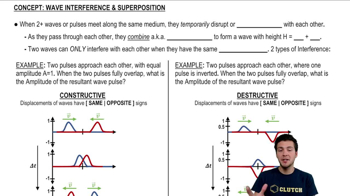
Interference patterns are the result of the superposition of waves, leading to regions of constructive and destructive interference. In the atom interferometer, the overlapping wave functions of the sodium atoms create distinct interference patterns that reveal information about their quantum states. These patterns serve as evidence of the wave-like behavior of matter, reinforcing the idea that quantum entities do not conform to classical trajectories but instead exhibit complex interactions that can be observed experimentally.
Recommended video:
Guided course
03:47
Wave Interference & Superposition