
Ch 40: One-Dimensional Quantum Mechanics
Knight Calc - Physics for Scientists and Engineers 5th Edition
Knight Calc5th EditionPhysics for Scientists and EngineersISBN: 9780137344796Not the one you use?Change textbook
Chapter 40, Problem 13

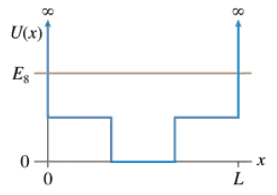
Sketch the n = 8 wave function for the potential energy shown in FIGURE EX40.13.

Verified step by step guidance
1
Understand the context: The wave function corresponds to the quantum mechanical solution of the Schrödinger equation for a particle in a potential energy well. The quantum number n=8 indicates the 8th energy level, which is associated with the 8th eigenstate of the system.
Recall the properties of wave functions: For a particle in a potential well, the wave function oscillates, and the number of nodes (points where the wave function crosses zero) is equal to n-1. For n=8, the wave function will have 7 nodes.
Analyze the potential energy diagram: Examine the shape of the potential energy well in FIGURE EX40.13. If it is a symmetric potential (e.g., a square well or harmonic oscillator), the wave function will exhibit symmetry or anti-symmetry about the center of the well. If the potential is asymmetric, the wave function will adapt to the shape of the well.
Sketch the wave function: Begin by marking the 7 nodes evenly spaced within the well. Between the nodes, the wave function will alternate between positive and negative values, with the amplitude decreasing as the energy level increases (due to normalization). Ensure the wave function tapers off smoothly at the boundaries of the well if the potential is finite.
Label the sketch: Clearly indicate the quantum number (n=8), the nodes, and the regions of positive and negative amplitude. If the potential well is symmetric, the wave function will be symmetric or anti-symmetric about the center, depending on whether n is even or odd.

Verified video answer for a similar problem:

This video solution was recommended by our tutors as helpful for the problem above.
Was this helpful?

Key Concepts

Here are the essential concepts you must grasp in order to answer the question correctly.

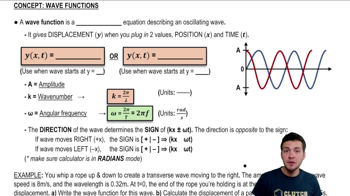
Quantum Wave Function

The wave function in quantum mechanics describes the quantum state of a particle or system. It contains all the information about the system's properties and is typically denoted by the Greek letter psi (Ψ). The square of the wave function's absolute value gives the probability density of finding a particle in a particular state or position.
Recommended video:
Guided course
08:30
Intro to Wave Functions

Quantum Numbers

Quantum numbers are values that describe the energy levels and other properties of electrons in an atom. For example, the principal quantum number (n) indicates the energy level and size of the orbital, while the angular momentum quantum number (l) describes the shape of the orbital. For n=8, the electron is in a high energy state, which influences the wave function's characteristics.
Recommended video:
Guided course
07:19
Moles & Avogadro's Number

Potential Energy in Quantum Mechanics

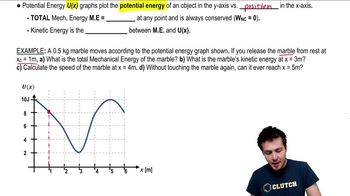
In quantum mechanics, the potential energy of a system influences the behavior of particles and their wave functions. The shape of the potential energy curve determines the allowed energy levels and corresponding wave functions. Understanding the potential energy profile is crucial for sketching the wave function, as it dictates the regions where the particle is likely to be found.
Recommended video:
Guided course
07:24
Potential Energy Graphs