
The resistivity of a metal increases slightly with increased temperature. This can be expressed as ρ=ρ₀[1+α(T−T₀)] , where T₀ is a reference temperature, usually 20°C, and α is the temperature coefficient of resistivity. For copper, α=3.9×10⁻³ °C−1. Suppose a 2.5-m-long, 0.40-mm-diameter copper wire is connected across the terminals of a 1.5 V ideal battery. What is the current in the wire at 20°C?
A hollow metal cylinder has inner radius a, outer radius b, length L, and conductivity σ. The current I is radially outward from the inner surface to the outer surface. Evaluate the electric field strength at the inner and outer surfaces of an iron cylinder if a=1.0 cm, b=2.5 cm, L=10 cm, and I=25 A.
Verified step by step guidance
Verified video answer for a similar problem:
Key Concepts
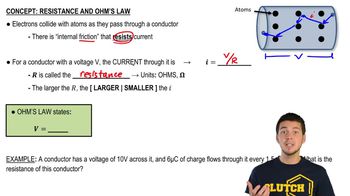
Ohm's Law
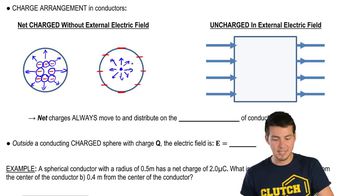
Electric Field in Conductors
Current Density
You need to design a 1.0 A fuse that 'blows' if the current exceeds 1.0 A. The fuse material in your stockroom melts at a current density of 500 A/cm2. What diameter wire of this material will do the job?
The total amount of charge in coulombs that has entered a wire at time t is given by the expression Q=4t−t2, where t is in seconds and t≥0. Graph I versus t for the interval 0≤t≤4 s.
The total amount of charge in coulombs that has entered a wire at time t is given by the expression Q=4t−t2, where t is in seconds and t≥0. Find an expression for the current in the wire at time .
Electrical engineers sometimes use a wire's conductance, G=σA/L, instead of its resistance. A 1.5 A current flows through the wire of part b. What is the potential difference between the ends of the wire?
Electrical engineers sometimes use a wire's conductance, G=σA/L, instead of its resistance. What is the conductance of a 5.4-cm-long, 0.15-mm-diameter tungsten wire?
