
Ch. 11 - Angular Momentum; General Rotation
Giancoli Douglas - Physics for Scientists and Engineers 5th edition
Giancoli Douglas5th editionPhysics for Scientists and EngineersISBN: 9780137488179Not the one you use?Change textbook
Chapter 11, Problem 9

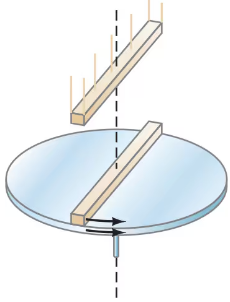
A uniform disk turns at 4.1 rev/s around a frictionless central axis. A nonrotating rod, of the same mass as the disk and length equal to the disk’s diameter, is dropped onto the freely spinning disk, Fig. 11–32. They then turn together around the spindle with their centers superposed. What is the angular frequency in rev/s of the combination?
A uniform disk spins while a nonrotating rod is dropped onto it, illustrating angular momentum conservation.

Verified step by step guidance
1
Start by identifying the principle of conservation of angular momentum. Since there are no external torques acting on the system, the total angular momentum before and after the rod is dropped must remain constant.
Write the expression for the initial angular momentum of the system. The disk is rotating with an angular velocity of \( \omega_i = 4.1 \; \text{rev/s} \). The moment of inertia of a uniform disk is \( I_{\text{disk}} = \frac{1}{2} M R^2 \), where \( M \) is the mass of the disk and \( R \) is its radius. Thus, the initial angular momentum is \( L_i = I_{\text{disk}} \omega_i \).
Next, calculate the moment of inertia of the rod. The rod is dropped onto the disk and rotates about its center. The moment of inertia of a uniform rod about its center is \( I_{\text{rod}} = \frac{1}{12} M L^2 \), where \( L \) is the length of the rod. Since the length of the rod equals the diameter of the disk, \( L = 2R \). Substitute \( L = 2R \) into the formula for \( I_{\text{rod}} \).
After the rod is dropped, the disk and rod rotate together as a single system. The total moment of inertia of the system is the sum of the individual moments of inertia: \( I_{\text{total}} = I_{\text{disk}} + I_{\text{rod}} \).
Apply the conservation of angular momentum: \( L_i = L_f \), where \( L_f = I_{\text{total}} \omega_f \). Solve for the final angular velocity \( \omega_f \) in terms of the given quantities: \( \omega_f = \frac{I_{\text{disk}} \omega_i}{I_{\text{total}}} \). Convert \( \omega_f \) back to revolutions per second (rev/s) if necessary.

Verified video answer for a similar problem:

This video solution was recommended by our tutors as helpful for the problem above.
Video duration:
7m
Was this helpful?

Key Concepts

Here are the essential concepts you must grasp in order to answer the question correctly.

Angular Momentum Conservation

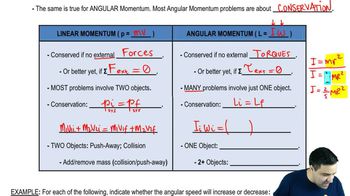
Angular momentum is a conserved quantity in a closed system, meaning that the total angular momentum before an event must equal the total angular momentum after the event, provided no external torques act on the system. In this scenario, the initial angular momentum of the spinning disk must equal the combined angular momentum of the disk and the rod after they are dropped together.
Recommended video:
Guided course
12:12
Conservation of Angular Momentum

Moment of Inertia

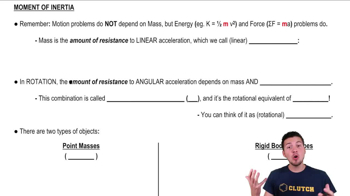
The moment of inertia is a measure of an object's resistance to changes in its rotational motion, depending on the mass distribution relative to the axis of rotation. For a uniform disk and a rod, their moments of inertia can be calculated using specific formulas, which are essential for determining the new angular frequency when they rotate together.
Recommended video:
Guided course
11:47
Intro to Moment of Inertia

Angular Frequency

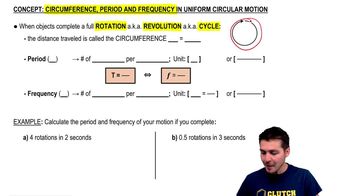
Angular frequency, often denoted as ω, is the rate of rotation expressed in radians per second, but can also be converted to revolutions per second (rev/s). It is crucial to understand how to relate angular frequency to angular momentum and moment of inertia, especially when combining two rotating bodies, as it helps in calculating the final state of the system.
Recommended video:
Guided course
05:08
Circumference, Period, and Frequency in UCM