
Ch. 16 - Sound
Giancoli Douglas - Physics for Scientists and Engineers 5th edition
Giancoli Douglas5th editionPhysics for Scientists and EngineersISBN: 9780137488179Not the one you use?Change textbook
Chapter 16, Problem 49

A guitar string produces 3 beat/s when sounded with a 350-Hz tuning fork and 8 beat/s when sounded with a 355-Hz tuning fork. What is the vibrational frequency of the string? Explain your reasoning.

Verified step by step guidance
1
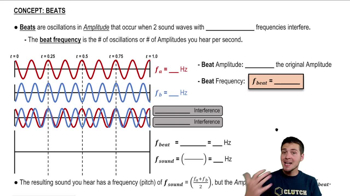
The phenomenon of beats occurs when two sound waves of slightly different frequencies interfere with each other. The beat frequency is equal to the absolute difference between the two frequencies: \( f_{\text{beat}} = |f_1 - f_2| \).
From the problem, the guitar string produces 3 beats per second with a 350-Hz tuning fork. This means the string's frequency \( f_s \) could either be \( 350 + 3 = 353 \, \text{Hz} \) or \( 350 - 3 = 347 \, \text{Hz} \).
Similarly, the string produces 8 beats per second with a 355-Hz tuning fork. This means the string's frequency \( f_s \) could either be \( 355 + 8 = 363 \, \text{Hz} \) or \( 355 - 8 = 347 \, \text{Hz} \).
To determine the correct frequency, compare the possible values from both cases. The only frequency that satisfies both conditions is \( f_s = 347 \; \text{Hz} \), as it produces 3 beats with 350 Hz and 8 beats with 355 Hz.
Thus, the vibrational frequency of the guitar string is \( f_s = 347 \; \text{Hz} \). This reasoning is based on the principle of beat frequency and the consistency of the results across both tuning forks.

Verified video answer for a similar problem:

This video solution was recommended by our tutors as helpful for the problem above.
Video duration:
3m
Was this helpful?

Key Concepts

Here are the essential concepts you must grasp in order to answer the question correctly.

Beats Frequency

Beats frequency occurs when two sound waves of slightly different frequencies interfere with each other, resulting in a periodic variation in amplitude. The beat frequency is equal to the absolute difference between the two frequencies. In this case, the guitar string's frequency can be determined by analyzing the beat frequencies produced with the tuning forks.
Recommended video:

Frequency of Sound Waves

Frequency, measured in Hertz (Hz), refers to the number of cycles of a wave that occur in one second. In the context of sound, it determines the pitch of the sound produced. The guitar string's frequency must be calculated based on the known frequencies of the tuning forks and the observed beat frequencies.
Recommended video:
Guided course
05:17
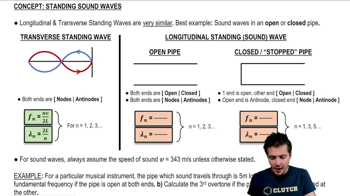
Standing Sound Waves

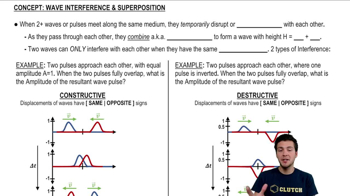
Interference of Waves

Interference occurs when two or more waves overlap, leading to a new wave pattern. Constructive interference amplifies the sound, while destructive interference diminishes it. Understanding how the guitar string interacts with the tuning forks through interference is crucial for determining its vibrational frequency based on the beat frequencies observed.
Recommended video:
Guided course
03:47
Wave Interference & Superposition