
Ch 30: Electromagnetic Induction
Knight Calc - Physics for Scientists and Engineers 5th Edition
Knight Calc5th EditionPhysics for Scientists and EngineersISBN: 9780137344796Not the one you use?Change textbook
Chapter 30, Problem 22a

Electricity is distributed from electrical substations to neighborhoods at 15,000 V. This is a 60 Hz oscillating (AC) voltage. Neighborhood transformers, seen on utility poles, step this voltage down to the 120 V that is delivered to your house. a. How many turns does the primary coil on the transformer have if the secondary coil has 100 turns?

Verified step by step guidance
1
Understand the problem: This is a transformer problem, which operates on the principle of electromagnetic induction. The relationship between the number of turns in the primary and secondary coils and their respective voltages is given by the transformer equation: VpVs = NpNs, where Vp and Vs are the primary and secondary voltages, and Np and Ns are the number of turns in the primary and secondary coils, respectively.
Identify the known values: From the problem, the primary voltage is 15,000 V, the secondary voltage is 120 V, and the number of turns in the secondary coil is 100 turns.
Rearrange the transformer equation to solve for the number of turns in the primary coil: Np = VpVsNs. This equation allows us to calculate the number of turns in the primary coil based on the given values.
Substitute the known values into the equation: Np = 15,000120100. Perform the division and multiplication to find the number of turns in the primary coil.
Interpret the result: The calculated value of Np represents the number of turns in the primary coil of the transformer. This value should be significantly larger than the number of turns in the secondary coil, as the primary voltage is much higher than the secondary voltage.

Verified video answer for a similar problem:

This video solution was recommended by our tutors as helpful for the problem above.
Was this helpful?

Key Concepts

Here are the essential concepts you must grasp in order to answer the question correctly.

Transformer Basics

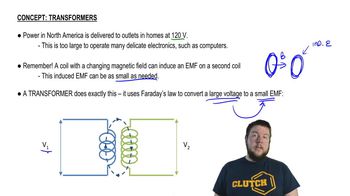
A transformer is an electrical device that transfers electrical energy between two or more circuits through electromagnetic induction. It consists of primary and secondary coils, where the primary coil receives the input voltage and the secondary coil delivers the output voltage. The voltage change between the coils is proportional to the ratio of the number of turns in each coil.
Recommended video:

Turns Ratio

The turns ratio of a transformer is the ratio of the number of turns in the primary coil to the number of turns in the secondary coil. This ratio determines how the voltage is transformed; if the primary coil has more turns than the secondary, the voltage is stepped down, while if it has fewer, the voltage is stepped up. The relationship can be expressed as Vp/Vs = Np/Ns, where V is voltage and N is the number of turns.
Recommended video:
Guided course
05:32
Ratio of energies of cylinder on surface

AC Voltage Characteristics

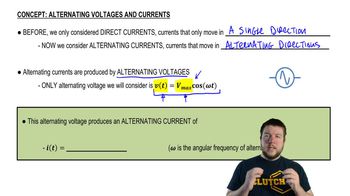
Alternating current (AC) voltage is characterized by its periodic oscillation, typically described by its frequency, measured in hertz (Hz). In this case, the 60 Hz frequency indicates that the voltage alternates direction 60 times per second. This oscillation is crucial for the operation of transformers, as they rely on changing magnetic fields to induce voltage in the secondary coil.
Recommended video:
Guided course
07:49
Alternating Voltages and Currents
Related Practice
Textbook Question

FIGURE EX30.19 shows the current as a function of time through a 20-cm-long, 4.0-cm-diameter solenoid with 400 turns. Draw a graph of the induced electric field strength as a function of time at a point 1.0 cm from the axis of the solenoid.

99
views
Textbook Question

A 12-cm-diameter, 1.0-m-long solenoid is wound with 2000 turns of superconducting wire. When the magnet is turned on, the current increases from 0 to Imax in 2.5 s. At t = 1.0 s, the induced electric field midway between the axis and the windings is 7.5×10⁻³ V/m. What is the solenoid's steady magnetic field strength?

68
views
Textbook Question

Electricity is distributed from electrical substations to neighborhoods at 15,000 V. This is a 60 Hz oscillating (AC) voltage. Neighborhood transformers, seen on utility poles, step this voltage down to the 120 V that is delivered to your house. No energy is lost in an ideal transformer, so the output power Pout from the secondary coil equals the input power Pin to the primary coil. Suppose a neighborhood transformer delivers 250 A at 120 V. What is the current in the 15,000 V line from the substation?

171
views
Textbook Question

How much energy is stored in a 3.0-cm-diameter, 12-cm-long solenoid that has 200 turns of wire and carries a current of 0.80 A?

1777
views
Textbook Question

What is the potential difference across a 10 mH inductor if the current through the inductor drops from 150 mA to 50 mA in 10 μs? What is the direction of this potential difference? That is, does the potential increase or decrease along the direction of the current?

135
views
Textbook Question

The magnetic field inside a 5.0-cm-diameter solenoid is 2.0 T and decreasing at 4.0 T/s. What is the electric field strength inside the solenoid at a point (a) on the axis and (b) 2.0 cm from the axis?

136
views