
Ch 16: Traveling Waves
Knight Calc - Physics for Scientists and Engineers 5th Edition
Knight Calc5th EditionPhysics for Scientists and EngineersISBN: 9780137344796Not the one you use?Change textbook
Chapter 16, Problem 72b

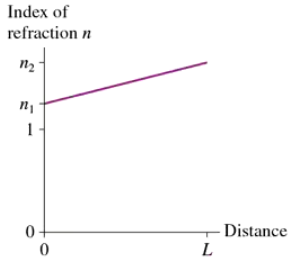
Some modern optical devices are made with glass whose index of refraction changes with distance from the front surface. FIGURE P16.72 shows the index of refraction as a function of the distance into a slab of glass of thickness L. The index of refraction increases linearly from n1 at the front surface to n₂ at the rear surface. Evaluate your expression for a 1.0-cm-thick piece of glass for which n1 = 1.50 and n2 = 1.60.

Verified step by step guidance
1
Step 1: Understand the problem. The index of refraction changes linearly with distance through the glass. This means the index of refraction, n(x), at a distance x from the front surface can be expressed as a linear function. The goal is to evaluate the expression for the given parameters: thickness L = 1.0 cm, n₁ = 1.50, and n₂ = 1.60.
Step 2: Write the linear equation for the index of refraction. Since the index of refraction changes linearly, we can express it as: n(x) = n₁ + (n₂ - n₁) * (x / L), where x is the distance from the front surface, L is the thickness of the glass, n₁ is the index of refraction at the front surface, and n₂ is the index of refraction at the rear surface.
Step 3: To evaluate the expression, substitute the given values into the equation. Use L = 1.0 cm, n₁ = 1.50, and n₂ = 1.60. The equation becomes: n(x) = 1.50 + (1.60 - 1.50) * (x / 1.0).
Step 4: Simplify the equation. The difference (1.60 - 1.50) is 0.10, so the equation becomes: n(x) = 1.50 + 0.10 * x. This is the linear expression for the index of refraction as a function of distance x.
Step 5: To evaluate the index of refraction at specific points within the glass, substitute the desired values of x (e.g., x = 0 cm for the front surface, x = 1.0 cm for the rear surface) into the simplified equation. For example, at x = 0, n(0) = 1.50 + 0.10 * 0, and at x = 1.0 cm, n(1.0) = 1.50 + 0.10 * 1.0.

Verified video answer for a similar problem:

This video solution was recommended by our tutors as helpful for the problem above.
Was this helpful?

Key Concepts

Here are the essential concepts you must grasp in order to answer the question correctly.

Index of Refraction

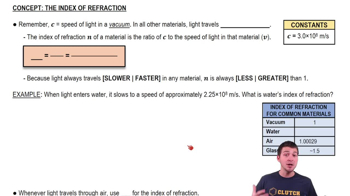
The index of refraction (n) is a dimensionless number that describes how light propagates through a medium. It is defined as the ratio of the speed of light in a vacuum to the speed of light in the medium. A higher index indicates that light travels slower in that medium, affecting how light bends when entering or exiting the material.
Recommended video:
Guided course
03:46
Index of Refraction

Linear Variation of Index of Refraction

In this context, the index of refraction varies linearly with distance, meaning it increases steadily from n₁ at the front surface to n₂ at the rear surface. This linear relationship can be expressed mathematically, allowing for the calculation of the effective index of refraction at any point within the slab, which is crucial for understanding light behavior in the material.
Recommended video:
Guided course
03:46
Index of Refraction

Snell's Law

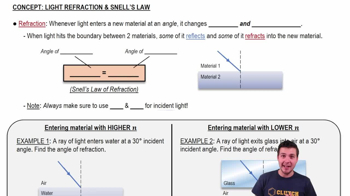
Snell's Law describes how light refracts when it passes from one medium to another with different indices of refraction. It states that the ratio of the sine of the angle of incidence to the sine of the angle of refraction is constant and equal to the ratio of the indices of refraction of the two media. This principle is essential for analyzing how light behaves as it travels through the varying index of refraction in the glass slab.
Recommended video:
Related Practice
Textbook Question

An avant-garde composer wants to use the Doppler effect in his new opera. As the soprano sings, he wants a large bat to fly toward her from the back of the stage. The bat will be outfitted with a microphone to pick up the singer's voice and a loudspeaker to rebroadcast the sound toward the audience. The composer wants the sound the audience hears from the bat to be, in musical terms, one half-step higher in frequency than the note they are hearing from the singer. Two notes a half-step apart have a frequency ratio of 21/12 = 1.059. With what speed must the bat fly toward the singer?

1632
views
Textbook Question

A battery-powered siren emits 0.50 W of sound power at 1000 Hz. It is dropped from 100 m directly over your head on a 20°C day. 4.0 s after it is released, what are (a) the frequency and (b) the sound intensity level you hear?

265
views
Textbook Question

A loudspeaker, mounted on a tall pole, is engineered to emit 75% of its sound energy into the forward hemisphere, 25% toward the back. You measure an 85 dB sound intensity level when standing 3.5 m in front of and 2.5 m below the speaker. What is the speaker's power output?

288
views
Textbook Question

A physics professor demonstrates the Doppler effect by tying a 600 Hz sound generator to a 1.0-m-long rope and whirling it around her head in a horizontal circle at 100 rpm. What are the highest and lowest frequencies heard by a student in the classroom?

882
views
Textbook Question

A 1000 Hz sound wave traveling through 20°C air causes the pressure to oscillate around atmospheric pressure by ±0.050%. What is the maximum speed of an oscillating air molecule? Give your answer in mm/s.

1714
views
Textbook Question

LASIK eye surgery uses pulses of laser light to shave off tissue from the cornea, reshaping it. A typical LASIK laser emits a 1.0-mm-diameter laser beam with a wavelength of 193 nm. Each laser pulse lasts 15 ns and contains 1.0 mJ of light energy. During the very brief time of the pulse, what is the intensity of the light wave?

1899
views