
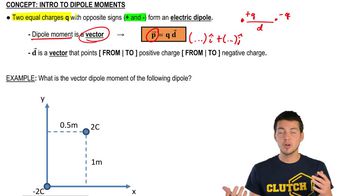
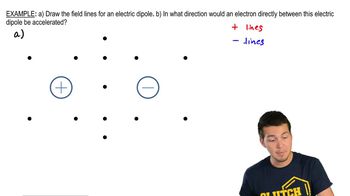
The electric field strength 1.5 cm from an electric dipole, on the axis of the dipole, is 1.5×10⁵ N/C. If the dipole is replaced by a single charge, what magnitude charge in nC will give the same field strength 1.5 cm away?
An electret is similar to a magnet, but rather than being permanently magnetized, it has a permanent electric dipole moment. Suppose a small electret with electric dipole moment 1.0×10⁻⁷ C m is 25 cm from a small ball charged to +25 nC, with the ball on the axis of the electric dipole. What is the magnitude of the electric force on the ball?
Verified step by step guidance
Verified video answer for a similar problem:
Key Concepts
Electric Dipole Moment
Coulomb's Law
Electric Field of a Dipole
The electric field strength 1.5 cm from an electric dipole, on the axis of the dipole, is 1.5×10⁵ N/C. What is the dipole moment in nC mm?
A 10-cm-long thin glass rod uniformly charged to +10 nC and a 10-cm-long thin plastic rod uniformly charged to −10 nC are placed side by side, 4.0 cm apart. What are the electric field strengths E1 to E3 at distances 1.0 cm, 2.0 cm, and 3.0 cm from the glass rod along the line connecting the midpoints of the two rods?
A small glass bead charged to +6.0 nC is in the plane that bisects a thin, uniformly charged, 10-cm-long glass rod and is 4.0 cm from the rod's center. The bead is repelled from the rod with a force of 840 μN. What is the total charge on the rod?
An electric dipole is formed from two charges, ±q, spaced 1.0 cm apart. The dipole is at the origin, oriented along the y-axis. The electric field strength at the point (x, y)=(0 cm, 10 cm) is 360 N/C. What is the charge q? Give your answer in nC.
Two 10-cm-long thin glass rods uniformly charged to +10 nC are placed side by side, 4.0 cm apart. What are the electric field strengths E1 to E3 at distances 1.0 cm, 2.0 cm, and 3.0 cm to the right of the rod on the left along the line connecting the midpoints of the two rods?
