
Ch 05: Applying Newton's Laws
Young & Freedman Calc - University Physics 14th Edition
Young & Freedman Calc14th EditionUniversity PhysicsISBN: 9780321973610Not the one you use?Change textbook
Chapter 5, Problem 53a

One problem for humans living in outer space is that they are apparently weightless. One way around this problem is to design a space station that spins about its center at a constant rate. This creates 'artificial gravity' at the outside rim of the station. If the diameter of the space station is 800800 m, how many revolutions per minute are needed for the 'artificial gravity' acceleration to be 9.809.80 m/s2?

Verified step by step guidance
1
Step 1: Understand the concept of artificial gravity. Artificial gravity is created by the centripetal acceleration experienced by objects on the rim of a rotating space station. The centripetal acceleration is given by the formula: a=rω2, where a is the centripetal acceleration, r is the radius of the space station, and ω is the angular velocity.
Step 2: Calculate the radius of the space station. The diameter is given as 800 m, so the radius is half of the diameter: r=8002=400 m.
Step 3: Rearrange the centripetal acceleration formula to solve for angular velocity ω. The formula becomes: ω=ar. Substitute the values for a (9.80 m/s²) and r (400 m) into the formula.
Step 4: Convert angular velocity ω to revolutions per minute (rpm). Angular velocity is typically measured in radians per second, so use the conversion factor: 1 revolutions per radian and multiply by 60 seconds per minute. The formula for rpm is: rpm=60ω.
Step 5: Substitute the calculated angular velocity ω into the rpm formula to find the number of revolutions per minute required for the artificial gravity acceleration to be 9.80 m/s².

Verified video answer for a similar problem:

This video solution was recommended by our tutors as helpful for the problem above.
Video duration:
9m
Was this helpful?

Key Concepts

Here are the essential concepts you must grasp in order to answer the question correctly.

Centripetal Acceleration

Centripetal acceleration is the acceleration directed towards the center of a circular path that keeps an object moving in that path. It is calculated using the formula a = v²/r, where 'v' is the tangential velocity and 'r' is the radius of the circular path. In the context of the space station, this acceleration mimics the effects of gravity for occupants.
Recommended video:
Guided course
06:48
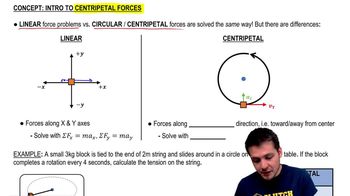
Intro to Centripetal Forces

Angular Velocity

Angular velocity is a measure of how quickly an object rotates around a central point, typically expressed in radians per second or revolutions per minute (RPM). It is related to linear velocity through the equation v = ωr, where 'ω' is the angular velocity and 'r' is the radius. Understanding angular velocity is crucial for determining how fast the space station must spin to achieve the desired artificial gravity.
Recommended video:
Guided course
06:18
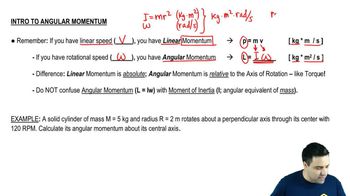
Intro to Angular Momentum

Artificial Gravity

Artificial gravity refers to the simulation of gravitational effects in a non-gravitational environment, such as space. This is achieved through centripetal force generated by rotating structures, like a spinning space station. By creating a force that acts outward from the center of rotation, occupants experience a sensation similar to gravity, which is essential for their physical well-being during long-term space missions.
Recommended video:
Guided course
05:20
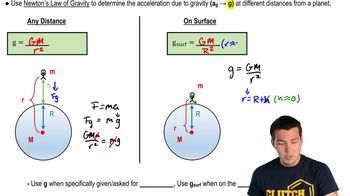
Acceleration Due to Gravity
Related Practice
Textbook Question

The Cosmo Clock 21 Ferris wheel in Yokohama, Japan, has a diameter of 100100 m. Its name comes from its 6060 arms, each of which can function as a second hand (so that it makes one revolution every 60.060.0 s). Find the speed of the passengers when the Ferris wheel is rotating at this rate.

2920
views
Textbook Question

The 'Giant Swing' at a county fair consists of a vertical central shaft with a number of horizontal arms attached at its upper end. Each arm supports a seat suspended from a cable 5.005.00 m long, and the upper end of the cable is fastened to the arm at a point 3.003.00 m from the central shaft (Fig. E5.505.50). Find the time of one revolution of the swing if the cable supporting a seat makes an angle of 30.0°30.0° with the vertical.

9130
views
4
comments
Textbook Question

The Cosmo Clock 21 Ferris wheel in Yokohama, Japan, has a diameter of 100100 m. Its name comes from its 6060 arms, each of which can function as a second hand (so that it makes one revolution every 60.060.0 s). What would be the time for one revolution if the passenger's apparent weight at the highest point were zero?

1785
views
Textbook Question

A 11251125-kg car and a 22502250-kg pickup truck approach a curve on a highway that has a radius of 225 225 m. At what angle should the highway engineer bank this curve so that vehicles traveling at 65.065.0 mi/h can safely round it regardless of the condition of their tires? Should the heavy truck go slower than the lighter car?

3848
views
Textbook Question

In another version of the 'Giant Swing' (see Exercise 5.505.50), the seat is connected to two cables, one of which is horizontal (Fig. E5.515.51). The seat swings in a horizontal circle at a rate of 28.028.0 rpm (rev/min). If the seat weighs 255255 N and an 825825-N person is sitting in it, find the tension in each cable.

5013
views
1
rank
1
comments
Textbook Question

The Cosmo Clock 21 Ferris wheel in Yokohama, Japan, has a diameter of 100100 m. Its name comes from its 6060 arms, each of which can function as a second hand (so that it makes one revolution every 60.060.0 s). A passenger weighs 882882 N at the weight-guessing booth on the ground. What is his apparent weight at the highest and at the lowest point on the Ferris wheel?

1696
views