Ch 22: Electric Charges and Forces
Knight Calc - Physics for Scientists and Engineers 5th Edition
Knight Calc5th EditionPhysics for Scientists and EngineersISBN: 9780137344796Not the one you use?Change textbook
Chapter 22, Problem 42a

Objects A and B are both positively charged. Both have a mass of 100 g, but A has twice the charge of B. When A and B are placed 10 cm apart, B experiences an electric force of 0.45 N. What is the charge on A?

Verified step by step guidance
1
Step 1: Start by identifying the relevant formula for the electric force between two charges. The formula is Coulomb's Law: F = k * (q_1 * q_2) / r^2, where F is the electric force, k is Coulomb's constant (8.99 × 10^9 \, N \, m^2 / C^2), q_1 and q_2 are the charges, and r is the distance between the charges.
Step 2: Assign the given values to the variables. The force F is 0.45 N, the distance r is 10 cm (convert to meters: r = 0.1 \, m), and the relationship between the charges is q_A = 2q_B.
Step 3: Substitute q_A = 2q_B into Coulomb's Law. The equation becomes: F = k * (2q_B * q_B) / r^2, which simplifies to F = k * (2q_B^2) / r^2.
Step 4: Rearrange the equation to solve for q_B. The equation becomes: q_B^2 = (F * r^2) / (2k). Take the square root to find q_B: q_B = sqrt((F * r^2) / (2k)).
Step 5: Once q_B is calculated, use the relationship q_A = 2q_B to find the charge on A. This completes the solution.

Verified video answer for a similar problem:

This video solution was recommended by our tutors as helpful for the problem above.
Video duration:
5m
Was this helpful?

Key Concepts

Here are the essential concepts you must grasp in order to answer the question correctly.

Coulomb's Law

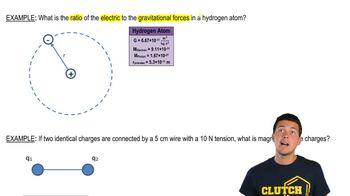
Coulomb's Law describes the electrostatic force between two charged objects. It states that the force is directly proportional to the product of the magnitudes of the charges and inversely proportional to the square of the distance between them. This law is fundamental for calculating the electric force acting between charged objects, which is essential for solving the problem at hand.
Recommended video:
Guided course
09:52
Coulomb's Law

Electric Charge

Electric charge is a property of matter that causes it to experience a force when placed in an electromagnetic field. Charges can be positive or negative, and like charges repel while opposite charges attract. In this scenario, understanding the relationship between the charges of objects A and B is crucial for determining the charge on A based on the given force experienced by B.
Recommended video:
Guided course
05:37
Electric Charge

Force Calculation

The calculation of force in physics often involves using formulas that relate mass, acceleration, and in this case, electric force. For charged objects, the force can be calculated using Coulomb's Law. Knowing the force experienced by B allows us to backtrack and find the charge on A, given that A has twice the charge of B.
Recommended video:
Guided course
06:09
Work Done by a Constant Force