Ch 29: The Magnetic Field
Knight Calc - Physics for Scientists and Engineers 5th Edition
Knight Calc5th EditionPhysics for Scientists and EngineersISBN: 9780137344796Not the one you use?Change textbook
Chapter 29, Problem 75a

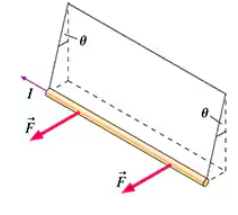
In FIGURE P29.75, a long, straight, current-carrying wire of linear mass density μ is suspended by threads. A magnetic field perpendicular to the wire exerts a horizontal force that deflects the wire to an equilibrium angle θ. Find an expression for the strength and direction of the magnetic field B.

Verified step by step guidance
1
Step 1: Analyze the forces acting on the wire. The wire is suspended at an angle θ due to the equilibrium between the gravitational force (acting vertically downward) and the magnetic force (acting horizontally). The tension in the threads has components balancing these forces.
Step 2: Write the expression for the gravitational force acting on the wire. The gravitational force is given by F_gravity = μ * g * L, where μ is the linear mass density, g is the acceleration due to gravity, and L is the length of the wire.
Step 3: Write the expression for the magnetic force acting on the wire. The magnetic force is given by F_magnetic = I * L * B, where I is the current in the wire, L is the length of the wire, and B is the magnetic field strength.
Step 4: Use trigonometry to relate the forces to the angle θ. The horizontal component of the tension balances the magnetic force, and the vertical component of the tension balances the gravitational force. Thus, tan(θ) = F_magnetic / F_gravity.
Step 5: Substitute the expressions for F_magnetic and F_gravity into the trigonometric relationship. This gives tan(θ) = (I * L * B) / (μ * g * L). Simplify to find B = (μ * g * tan(θ)) / I. The direction of the magnetic field can be determined using the right-hand rule based on the direction of the current and the force.

Verified video answer for a similar problem:

This video solution was recommended by our tutors as helpful for the problem above.
Was this helpful?

Key Concepts

Here are the essential concepts you must grasp in order to answer the question correctly.

Magnetic Force on a Current-Carrying Wire

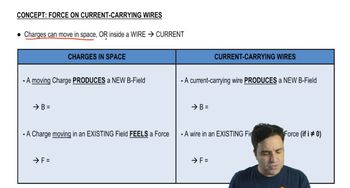
When a current-carrying wire is placed in a magnetic field, it experiences a magnetic force. This force is given by the equation F = I(L × B), where F is the force, I is the current, L is the length of the wire, and B is the magnetic field. The direction of the force can be determined using the right-hand rule, which states that if you point your thumb in the direction of the current and your fingers in the direction of the magnetic field, your palm will face the direction of the force.
Recommended video:
Guided course
09:57
Magnetic Force on Current-Carrying Wire

Equilibrium of Forces

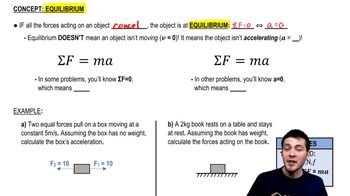
In this scenario, the wire reaches an equilibrium angle θ when the magnetic force acting on it is balanced by the gravitational force. The tension in the supporting threads also plays a role in maintaining this equilibrium. The net force acting on the wire must equal zero, which allows us to set up equations based on the forces involved to solve for the magnetic field strength.
Recommended video:

Linear Mass Density

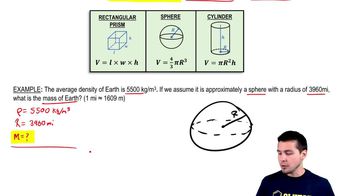
Linear mass density (μ) is defined as the mass per unit length of the wire, expressed as μ = m/L, where m is the mass and L is the length. This concept is crucial for understanding the gravitational force acting on the wire, which can be calculated as F_gravity = μgL, where g is the acceleration due to gravity. This relationship helps in determining the conditions for equilibrium when analyzing the forces acting on the wire.
Recommended video:
Guided course
04:33
Problems with Mass, Volume, & Density
Related Practice
Textbook Question

It is shown in more advanced courses that charged particles in circular orbits radiate electromagnetic waves, called cyclotron radiation. As a result, a particle undergoing cyclotron motion with speed v is actually losing kinetic energy at the ratedKdt=(μ0q46πcm2)B2v2\(\frac{dK}{dt}\) = - \(\left\)( \(\frac{\mu_0 q^4}{6\pi c m^2}\) \(\right\)) B^2 v^2

How long does it take (a) an electron and (b) a proton to radiate away half its energy while spiraling in a 2.0 T magnetic field?

217
views
Textbook Question

A scientist measuring the resistivity of a new metal alloy left her ammeter in another lab, but she does have a magnetic field probe. So she creates a 6.5-m-long, 2.0-mm-diameter wire of the material, connects it to a 1.5 V battery, and measures a 3.0 mT magnetic field 1.0 mm from the surface of the wire. What is the material's resistivity?

66
views
Textbook Question

A wire along the x-axis carries current I in the negative x-direction through the magnetic field B={B0xlk^0xl0elsewhere\(\vec{B}\)= \(\begin{cases}\) B_0\(\dfrac{x}{l}\]\hat{k}\) & 0 \(\leq\) x \(\leq\) l \\ 0 & \(\text{elsewhere}\) \(\end{cases}\). Find an expression for the net torque on the wire about the point x = 0.

450
views
Textbook Question

Controlled fusion is a possible future energy source that would harness the same nuclear fusion reactions that power the sun. The simplest fusion reaction is ²H⁺ + ²H⁺ → ³He⁺⁺ + n + energy, in which nuclei of two deuterium atoms fuse into a nucleus while ejecting a neutron and releasing a substantial amount of energy. Deuterium is not an element but is the name given to 'heavy hydrogen,' in which the nucleus is not simply a proton but a proton and a neutron, with atomic mass 2 u. Two positive deuterium nuclei, which repel each other, can get close enough to fuse only if they have very high speeds. This can be achieved by creating a plasma of ionized deuterium gas at a temperature of 1.0 x 10⁸ K. No material substance can contain a plasma at this temperature, so the idea is to contain the plasma with magnetic fields. Consider the simplest model of using a solenoid to confine the ions to cyclotron motion around the field lines. The plasma ions have a range of speeds, and it's necessary to contain all the ions with speeds up to three times the rms speed at the plasma temperature. What magnetic field strength is needed to keep the fastest ions in 20-cm-diameter cyclotron orbits? The actual magnetic fields are considerably more complex, but your answer is a reasonable estimate of the required field strengths.

285
views
Textbook Question

An electromagnetic rail gun uses magnetic forces to launch projectiles. FIGURE P29.76 shows a 10-cm-long, 10 g metal wire that can slide without friction along 1.0-m-long horizontal rails. The rails are connected to a 300 V source, and a 0.10 T magnetic field fills the space between the rails. Each rail has linear resistivity ⋋ = 0.10 Ω/m, which means that the resistance is ⋋ multiplied by the length of rail through which current flows. Assume that the sliding wire and the left end, where the voltage source is, have zero resistance. The wire is initially placed at x₀ = 5.0 cm then the switch is closed. What is the wire's speed as it leaves the rails?

1050
views
Textbook Question

A proton moves in the uniform fields E = 2500 k V/m and B = 0.50 k T. At t = 0 s the proton is moving in a 1.0-cm-diameter circle in the xy-plane. How many revolutions will the proton have made during this time interval?

242
views