
When all other quantities remain the same, how does the indicated change affect the minimum sample size requirement? Explain. b. Increase in the error tolerance
Verified step by step guidance
1
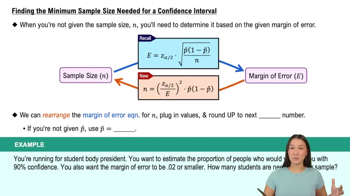
Understand the relationship between the sample size (n), error tolerance (E), and other factors. The formula for determining the minimum sample size in many cases is: , where z is the z-score, σ is the population standard deviation, and E is the error tolerance.
Notice that the error tolerance (E) appears in the denominator of the formula, squared. This means that as E increases, the denominator becomes larger, which reduces the overall value of n.
Conclude that an increase in the error tolerance (E) will result in a decrease in the minimum sample size requirement, assuming all other quantities remain constant.
Explain why this happens: A larger error tolerance means we are willing to accept a less precise estimate, so fewer data points (a smaller sample size) are needed to achieve this level of precision.
Summarize: Increasing the error tolerance reduces the minimum sample size because the precision requirement is relaxed, leading to a smaller denominator in the sample size formula.
Verified video answer for a similar problem:
This video solution was recommended by our tutors as helpful for the problem above
Video duration:
1m
Play a video:
0 Comments
Key Concepts
Here are the essential concepts you must grasp in order to answer the question correctly.
Sample Size
Sample size refers to the number of observations or data points collected in a study. It is crucial for ensuring that the results are statistically significant and can be generalized to a larger population. A larger sample size typically leads to more reliable estimates of population parameters.
Error tolerance, often referred to as margin of error, indicates the range within which the true population parameter is expected to fall. Increasing the error tolerance means allowing for a wider range of possible values, which can reduce the required sample size since less precision is needed in the estimates.
Finding the Minimum Sample Size Needed for a Confidence Interval
Statistical Power
Statistical power is the probability that a test will correctly reject a false null hypothesis. It is influenced by sample size, effect size, and significance level. When error tolerance increases, the power of the test may decrease if the sample size is not adjusted accordingly, potentially leading to less reliable conclusions.