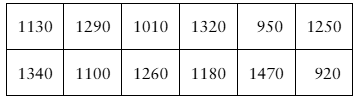
Constructing a Confidence Interval In Exercises 25–28, use the data set to (c) construct a 99% confidence interval for the population mean. Assume the population is normally distributed. SAT Scores The SAT scores of 12 randomly selected high school seniors
Verified step by step guidance
1
Step 1: Calculate the sample mean (x̄) by summing all the SAT scores provided in the data set and dividing by the total number of scores (n = 12). Use the formula: x̄ = (Σx) / n.
Step 2: Compute the sample standard deviation (s) using the formula: s = sqrt((Σ(x - x̄)^2) / (n - 1)), where x̄ is the sample mean and n is the sample size.
Step 3: Determine the critical value (t*) for a 99% confidence level using a t-distribution table. The degrees of freedom (df) are calculated as n - 1 (df = 12 - 1 = 11).
Step 4: Calculate the margin of error (E) using the formula: E = t* × (s / sqrt(n)), where s is the sample standard deviation and n is the sample size.
Step 5: Construct the confidence interval for the population mean using the formula: Confidence Interval = x̄ ± E, where x̄ is the sample mean and E is the margin of error.
Verified video answer for a similar problem:
This video solution was recommended by our tutors as helpful for the problem above
Video duration:
3m
Play a video:
0 Comments
Key Concepts
Here are the essential concepts you must grasp in order to answer the question correctly.
Confidence Interval
A confidence interval is a range of values, derived from sample statistics, that is likely to contain the population parameter with a specified level of confidence. For example, a 99% confidence interval suggests that if we were to take many samples and construct intervals in the same way, approximately 99% of those intervals would contain the true population mean.
Normal distribution is a probability distribution that is symmetric about the mean, showing that data near the mean are more frequent in occurrence than data far from the mean. In constructing confidence intervals, it is often assumed that the population from which the sample is drawn is normally distributed, especially when the sample size is small.
Using the Normal Distribution to Approximate Binomial Probabilities
Sample Mean and Standard Deviation
The sample mean is the average of a set of values, calculated by summing all the observations and dividing by the number of observations. The sample standard deviation measures the amount of variation or dispersion in a set of values. Both the sample mean and standard deviation are crucial for calculating the confidence interval, as they provide the necessary statistics to estimate the range around the population mean.