
In Exercise 26, add data for an international soccer player who can perform the half squat with a maximum of 210 kilograms and can sprint 10 meters in 2.00 seconds. Describe how this affects the correlation coefficient r.
Table of contents
- 1. Intro to Stats and Collecting Data1h 14m
- 2. Describing Data with Tables and Graphs1h 55m
- 3. Describing Data Numerically2h 5m
- 4. Probability2h 16m
- 5. Binomial Distribution & Discrete Random Variables3h 6m
- 6. Normal Distribution and Continuous Random Variables2h 11m
- 7. Sampling Distributions & Confidence Intervals: Mean3h 23m
- Sampling Distribution of the Sample Mean and Central Limit Theorem19m
- Distribution of Sample Mean - Excel23m
- Introduction to Confidence Intervals15m
- Confidence Intervals for Population Mean1h 18m
- Determining the Minimum Sample Size Required12m
- Finding Probabilities and T Critical Values - Excel28m
- Confidence Intervals for Population Means - Excel25m
- 8. Sampling Distributions & Confidence Intervals: Proportion1h 25m
- 9. Hypothesis Testing for One Sample3h 29m
- 10. Hypothesis Testing for Two Samples4h 50m
- Two Proportions1h 13m
- Two Proportions Hypothesis Test - Excel28m
- Two Means - Unknown, Unequal Variance1h 3m
- Two Means - Unknown Variances Hypothesis Test - Excel12m
- Two Means - Unknown, Equal Variance15m
- Two Means - Unknown, Equal Variances Hypothesis Test - Excel9m
- Two Means - Known Variance12m
- Two Means - Sigma Known Hypothesis Test - Excel21m
- Two Means - Matched Pairs (Dependent Samples)42m
- Matched Pairs Hypothesis Test - Excel12m
- 11. Correlation1h 24m
- 12. Regression1h 50m
- 13. Chi-Square Tests & Goodness of Fit2h 21m
- 14. ANOVA1h 57m
11. Correlation
Correlation Coefficient
Problem 10.RE.3a
Textbook Question
Time and Motion In a physics experiment at Doane College, a soccer ball was thrown upward from the bed of a moving truck. The table below lists the time (sec) that has lapsed from the throw and the corresponding height (m) of the soccer ball.
[IMAGE]
a. Find the value of the linear correlation coefficient r.
Verified step by step guidance1
Step 1: Understand the problem. The goal is to calculate the linear correlation coefficient (r), which measures the strength and direction of the linear relationship between two variables: time (x) and height (y).
Step 2: Use the formula for the linear correlation coefficient: r = (nΣ(xy) - ΣxΣy) / sqrt([(nΣ(x^2) - (Σx)^2)][(nΣ(y^2) - (Σy)^2)]). Here, n is the number of data points, Σ(xy) is the sum of the product of x and y, Σx and Σy are the sums of x and y respectively, Σ(x^2) is the sum of the squares of x, and Σ(y^2) is the sum of the squares of y.
Step 3: Organize the data into a table with columns for x (time), y (height), x^2, y^2, and xy. Compute the values for each column and sum them up to find Σx, Σy, Σ(x^2), Σ(y^2), and Σ(xy).
Step 4: Substitute the computed sums and the number of data points (n) into the formula for r. Simplify the numerator and denominator separately before dividing.
Step 5: Interpret the value of r. If r is close to 1 or -1, it indicates a strong linear relationship. If r is close to 0, it indicates a weak or no linear relationship.
Verified video answer for a similar problem:This video solution was recommended by our tutors as helpful for the problem above
Video duration:
1mPlay a video:
Was this helpful?
Key Concepts
Here are the essential concepts you must grasp in order to answer the question correctly.
Linear Correlation Coefficient (r)
The linear correlation coefficient, denoted as r, quantifies the strength and direction of a linear relationship between two variables. Its value ranges from -1 to 1, where 1 indicates a perfect positive correlation, -1 indicates a perfect negative correlation, and 0 signifies no correlation. Understanding how to calculate and interpret r is essential for analyzing the relationship between the time elapsed and the height of the soccer ball in the given experiment.
Recommended video:
Guided course
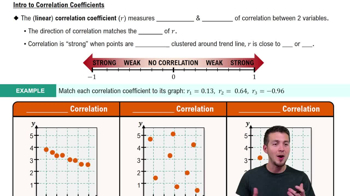
Correlation Coefficient
Data Representation
Data representation involves organizing and displaying data in a way that makes it easier to analyze and interpret. In this context, the height of the soccer ball over time can be represented in a table or graph, which helps visualize the relationship between the two variables. Proper data representation is crucial for identifying trends and patterns that inform the calculation of the correlation coefficient.
Recommended video:
Guided course
Visualizing Qualitative vs. Quantitative Data
Statistical Significance
Statistical significance refers to the likelihood that a relationship observed in data is not due to random chance. In the context of calculating the correlation coefficient, it is important to assess whether the correlation found is statistically significant, which can be determined through hypothesis testing. This concept helps in making informed conclusions about the relationship between the time and height of the soccer ball in the experiment.
Recommended video:
Guided course
Parameters vs. Statistics
Watch next
Master Correlation Coefficient with a bite sized video explanation from Patrick
Start learningRelated Videos
Related Practice
Textbook Question
14
views
