
4. Give examples of two variables that have perfect positive linear correlation and two variables that have perfect negative linear correlation.
Table of contents
- 1. Intro to Stats and Collecting Data1h 14m
- 2. Describing Data with Tables and Graphs1h 55m
- 3. Describing Data Numerically2h 5m
- 4. Probability2h 16m
- 5. Binomial Distribution & Discrete Random Variables3h 6m
- 6. Normal Distribution and Continuous Random Variables2h 11m
- 7. Sampling Distributions & Confidence Intervals: Mean3h 23m
- Sampling Distribution of the Sample Mean and Central Limit Theorem19m
- Distribution of Sample Mean - Excel23m
- Introduction to Confidence Intervals15m
- Confidence Intervals for Population Mean1h 18m
- Determining the Minimum Sample Size Required12m
- Finding Probabilities and T Critical Values - Excel28m
- Confidence Intervals for Population Means - Excel25m
- 8. Sampling Distributions & Confidence Intervals: Proportion1h 25m
- 9. Hypothesis Testing for One Sample3h 29m
- 10. Hypothesis Testing for Two Samples4h 50m
- Two Proportions1h 13m
- Two Proportions Hypothesis Test - Excel28m
- Two Means - Unknown, Unequal Variance1h 3m
- Two Means - Unknown Variances Hypothesis Test - Excel12m
- Two Means - Unknown, Equal Variance15m
- Two Means - Unknown, Equal Variances Hypothesis Test - Excel9m
- Two Means - Known Variance12m
- Two Means - Sigma Known Hypothesis Test - Excel21m
- Two Means - Matched Pairs (Dependent Samples)42m
- Matched Pairs Hypothesis Test - Excel12m
- 11. Correlation1h 24m
- 12. Regression1h 50m
- 13. Chi-Square Tests & Goodness of Fit2h 21m
- 14. ANOVA1h 57m
11. Correlation
Correlation Coefficient
Problem 9.1.32
Textbook Question
In Exercise 26, add data for an international soccer player who can perform the half squat with a maximum of 210 kilograms and can sprint 10 meters in 2.00 seconds. Describe how this affects the correlation coefficient r.
Verified step by step guidance1
Understand the problem: The task involves adding a new data point to an existing dataset and analyzing how this new data point affects the correlation coefficient (r). The correlation coefficient measures the strength and direction of the linear relationship between two variables—in this case, maximum squat weight and sprint time.
Identify the variables: The two variables are (1) maximum squat weight (in kilograms) and (2) sprint time (in seconds). The new data point is (210, 2.00).
Determine the impact of the new data point: Consider whether the new data point aligns with the existing trend in the dataset. If the new data point strengthens the linear relationship, the magnitude of r will increase (closer to 1 or -1). If it weakens the relationship, the magnitude of r will decrease (closer to 0).
Recalculate the correlation coefficient: Use the formula for the Pearson correlation coefficient: . Here, x represents squat weight, y represents sprint time, and x̄ and ȳ are their respective means. Add the new data point to the dataset and compute the updated r.
Interpret the result: After recalculating r, compare it to the original value. If the new data point is consistent with the existing trend, r will likely increase in magnitude. If it deviates significantly from the trend, r will decrease in magnitude. This interpretation helps understand the influence of the new data point on the relationship between squat weight and sprint time.
Verified video answer for a similar problem:This video solution was recommended by our tutors as helpful for the problem above
Video duration:
4mPlay a video:
Was this helpful?
Key Concepts
Here are the essential concepts you must grasp in order to answer the question correctly.
Correlation Coefficient (r)
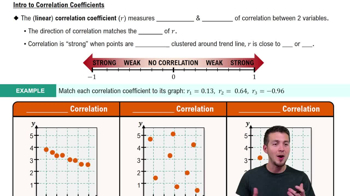
The correlation coefficient, denoted as r, quantifies the strength and direction of a linear relationship between two variables. It ranges from -1 to 1, where 1 indicates a perfect positive correlation, -1 a perfect negative correlation, and 0 no correlation. Understanding r is crucial for interpreting how changes in one variable may relate to changes in another, such as the relationship between an athlete's strength and speed.
Recommended video:
Guided course
Correlation Coefficient
Half Squat Performance
The half squat is a strength training exercise that targets the lower body, particularly the quadriceps, hamstrings, and glutes. An athlete's ability to perform a half squat with a maximum weight, such as 210 kilograms, can indicate their overall strength and power. This performance metric can be correlated with other athletic abilities, such as sprinting speed, to assess how strength influences speed in sports.
Recommended video:
Performing Hypothesis Tests: Proportions Example 1
Sprinting Speed
Sprinting speed refers to the time it takes an athlete to cover a specific distance, in this case, 10 meters in 2.00 seconds. This measure is critical in sports performance, as it reflects an athlete's explosive power and acceleration. Analyzing the relationship between sprinting speed and strength metrics, like half squat performance, can provide insights into how these physical attributes interact and contribute to overall athletic performance.
Recommended video:
Guided course
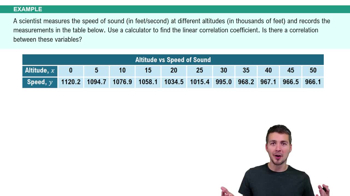
Calculating Correlation Coefficient - Graphing Calculator Example 1
Watch next
Master Correlation Coefficient with a bite sized video explanation from Patrick
Start learningRelated Videos
Related Practice
Textbook Question
42
views
