In Exercise 25, remove the data for the international soccer player with a maximum weight of 170 kilograms and a jump height of 64 centimeters. Describe how this affects the correlation coefficient r.
Table of contents
- 1. Intro to Stats and Collecting Data1h 14m
- 2. Describing Data with Tables and Graphs1h 55m
- 3. Describing Data Numerically2h 5m
- 4. Probability2h 16m
- 5. Binomial Distribution & Discrete Random Variables3h 6m
- 6. Normal Distribution and Continuous Random Variables2h 11m
- 7. Sampling Distributions & Confidence Intervals: Mean3h 23m
- Sampling Distribution of the Sample Mean and Central Limit Theorem19m
- Distribution of Sample Mean - Excel23m
- Introduction to Confidence Intervals15m
- Confidence Intervals for Population Mean1h 18m
- Determining the Minimum Sample Size Required12m
- Finding Probabilities and T Critical Values - Excel28m
- Confidence Intervals for Population Means - Excel25m
- 8. Sampling Distributions & Confidence Intervals: Proportion1h 25m
- 9. Hypothesis Testing for One Sample3h 29m
- 10. Hypothesis Testing for Two Samples4h 50m
- Two Proportions1h 13m
- Two Proportions Hypothesis Test - Excel28m
- Two Means - Unknown, Unequal Variance1h 3m
- Two Means - Unknown Variances Hypothesis Test - Excel12m
- Two Means - Unknown, Equal Variance15m
- Two Means - Unknown, Equal Variances Hypothesis Test - Excel9m
- Two Means - Known Variance12m
- Two Means - Sigma Known Hypothesis Test - Excel21m
- Two Means - Matched Pairs (Dependent Samples)42m
- Matched Pairs Hypothesis Test - Excel12m
- 11. Correlation1h 24m
- 12. Regression1h 50m
- 13. Chi-Square Tests & Goodness of Fit2h 21m
- 14. ANOVA1h 57m
11. Correlation
Correlation Coefficient
Problem 7.3.6b
Textbook Question
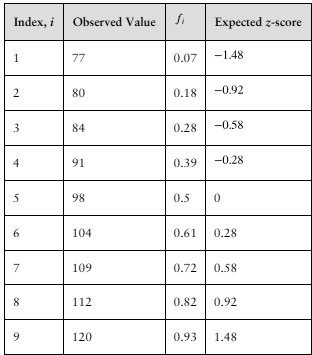
In Problems 3–6, use the results in the table to (b) determine the linear correlation between the observed values and expected z-scores, (c) determine the critical value in Table VI to assess the normality of the data.

Verified step by step guidance1
Step 1: Understand the data provided. You have observed values, their corresponding relative frequencies \(f_i\), and expected z-scores. The goal is to analyze the linear correlation between the observed values and expected z-scores, and then assess normality using a critical value from Table VI.
Step 2: To determine the linear correlation coefficient \(r\) between the observed values and expected z-scores, use the formula for Pearson's correlation coefficient:
\[r = \frac{\sum (x_i - \bar{x})(y_i - \bar{y})}{\sqrt{\sum (x_i - \bar{x})^2 \sum (y_i - \bar{y})^2}}\]
where \(x_i\) are the observed values, \(y_i\) are the expected z-scores, \(\bar{x}\) is the mean of observed values, and \(\bar{y}\) is the mean of expected z-scores.
Step 3: Calculate the means \(\bar{x}\) and \(\bar{y}\) of the observed values and expected z-scores respectively. Then compute the deviations \((x_i - \bar{x})\) and \((y_i - \bar{y})\) for each pair, multiply these deviations, and sum them up. Also calculate the sums of squared deviations for both variables.
Step 4: Substitute these sums into the formula for \(r\) to find the correlation coefficient. This value will indicate how closely the observed values and expected z-scores are linearly related.
Step 5: To determine the critical value from Table VI for assessing normality, identify the sample size \(n\) (which is the number of data points), then look up the critical value corresponding to \(n\) and the chosen significance level (commonly 0.05). This critical value will be used to compare against the correlation coefficient to decide if the data significantly deviates from normality.
Verified video answer for a similar problem:This video solution was recommended by our tutors as helpful for the problem above
Video duration:
4mPlay a video:
Was this helpful?
Key Concepts
Here are the essential concepts you must grasp in order to answer the question correctly.
Linear Correlation
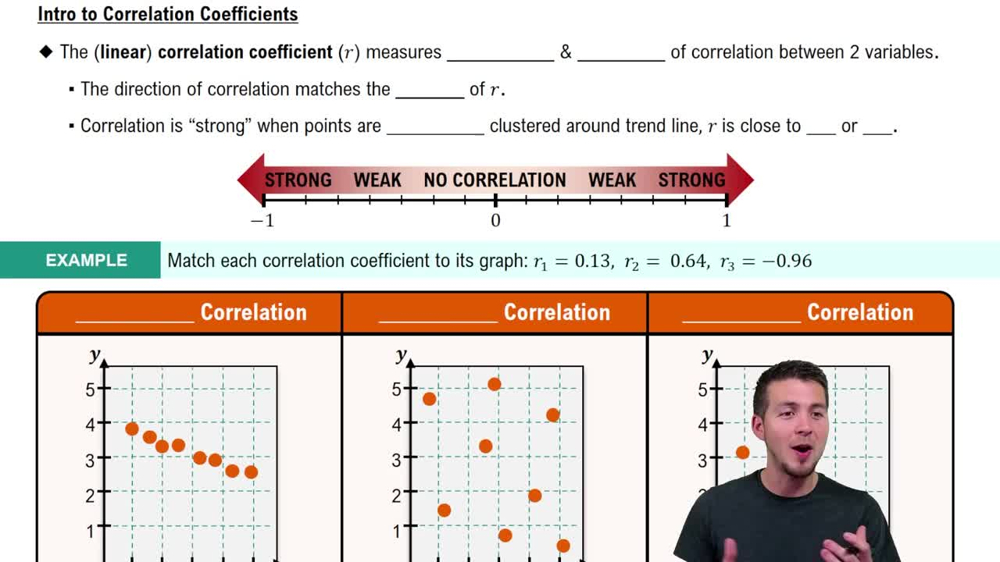
Linear correlation measures the strength and direction of a linear relationship between two variables. It is quantified by the correlation coefficient, which ranges from -1 to 1. A value close to 1 indicates a strong positive linear relationship, while a value near 0 suggests no linear relationship. In this context, it helps assess how well observed values align with expected z-scores.
Recommended video:
Guided course
Correlation Coefficient
Expected z-scores
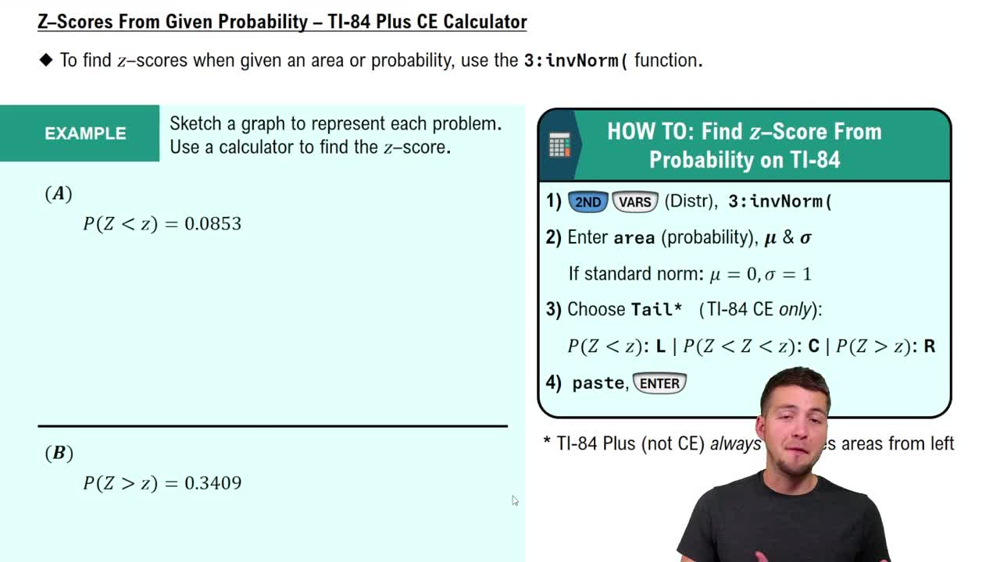
Expected z-scores represent standardized values assuming the data follows a normal distribution. They indicate how many standard deviations an observation is from the mean. Comparing observed values to expected z-scores helps evaluate if the data fits a normal distribution, which is essential for many statistical tests.
Recommended video:
Guided course
Z-Scores From Given Probability - TI-84 (CE) Calculator
Critical Value and Normality Test
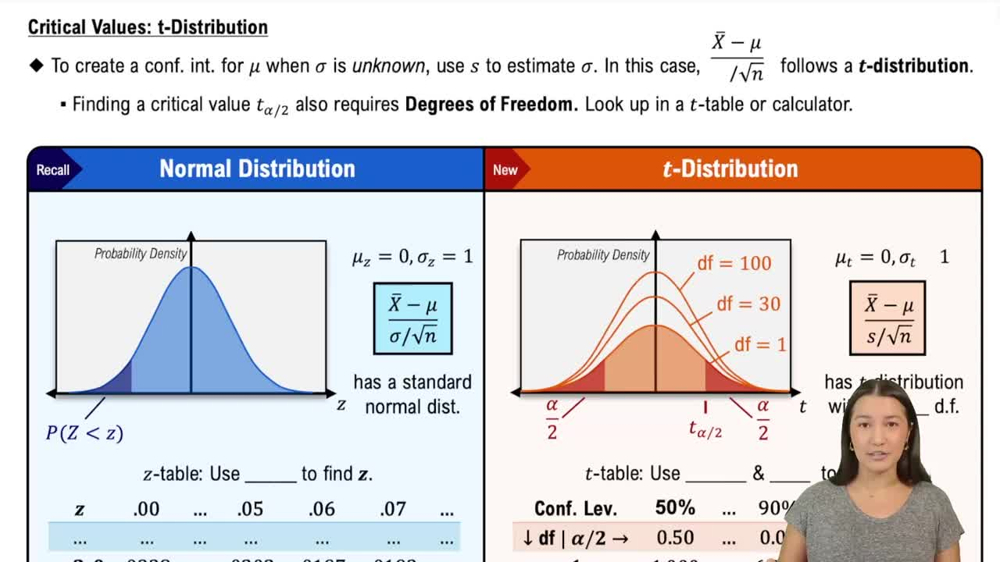
A critical value is a threshold from a statistical table used to decide whether to reject a null hypothesis. In normality tests, it helps determine if the data significantly deviates from a normal distribution. Comparing a test statistic to the critical value from Table VI allows assessment of the data's normality.
Recommended video:
Critical Values: t-Distribution
Watch next
Master Correlation Coefficient with a bite sized video explanation from Patrick
Start learningRelated Videos
Related Practice
Textbook Question
12
views