The TIMMS Exam The Trends in International Mathematics and Science (TIMMS) is a mathematics and science achievement exam given internationally. On each exam, students are asked to respond to a variety of background questions. For the 41 nations that participated in TIMMS, the correlation between the percentage of items answered in the background questionnaire (used as a proxy for student task persistence) and mean score on the exam was 0.79. Does this suggest there is a linear relation between student task persistence and achievement score? Write a sentence that explains what this result might mean.
Table of contents
- 1. Intro to Stats and Collecting Data1h 14m
- 2. Describing Data with Tables and Graphs1h 55m
- 3. Describing Data Numerically2h 5m
- 4. Probability2h 16m
- 5. Binomial Distribution & Discrete Random Variables3h 6m
- 6. Normal Distribution and Continuous Random Variables2h 11m
- 7. Sampling Distributions & Confidence Intervals: Mean3h 23m
- Sampling Distribution of the Sample Mean and Central Limit Theorem19m
- Distribution of Sample Mean - Excel23m
- Introduction to Confidence Intervals15m
- Confidence Intervals for Population Mean1h 18m
- Determining the Minimum Sample Size Required12m
- Finding Probabilities and T Critical Values - Excel28m
- Confidence Intervals for Population Means - Excel25m
- 8. Sampling Distributions & Confidence Intervals: Proportion1h 25m
- 9. Hypothesis Testing for One Sample3h 29m
- 10. Hypothesis Testing for Two Samples4h 50m
- Two Proportions1h 13m
- Two Proportions Hypothesis Test - Excel28m
- Two Means - Unknown, Unequal Variance1h 3m
- Two Means - Unknown Variances Hypothesis Test - Excel12m
- Two Means - Unknown, Equal Variance15m
- Two Means - Unknown, Equal Variances Hypothesis Test - Excel9m
- Two Means - Known Variance12m
- Two Means - Sigma Known Hypothesis Test - Excel21m
- Two Means - Matched Pairs (Dependent Samples)42m
- Matched Pairs Hypothesis Test - Excel12m
- 11. Correlation1h 24m
- 12. Regression1h 50m
- 13. Chi-Square Tests & Goodness of Fit2h 21m
- 14. ANOVA1h 57m
11. Correlation
Correlation Coefficient
Problem 12.1.29d
Textbook Question
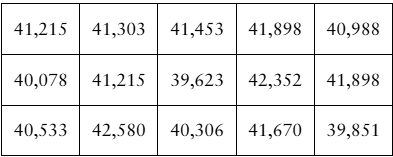
[DATA] Buying a New Car How much does the typical person pay for a new 2019 Audi A4? The following data represent the selling price of a random sample of new A4s (in dollars).

d. Verify it is reasonable to conclude that this data come from a population that is normally distributed.
Verified step by step guidance1
Step 1: Understand the goal is to verify if the sample data can be reasonably assumed to come from a normally distributed population. This involves checking the shape and characteristics of the data distribution.
Step 2: Create a visual representation of the data, such as a histogram or a normal probability plot (Q-Q plot), to visually assess if the data roughly follows a bell-shaped curve or aligns closely with the normal distribution line.
Step 3: Calculate descriptive statistics such as the sample mean and sample standard deviation to summarize the data's central tendency and spread.
Step 4: Compute skewness and kurtosis statistics or use formal normality tests (e.g., Shapiro-Wilk test or Anderson-Darling test) to quantitatively assess the normality of the data distribution.
Step 5: Interpret the results from the visual and statistical tests. If the histogram is symmetric and bell-shaped, the Q-Q plot points lie close to the line, and the normality tests do not reject the null hypothesis, then it is reasonable to conclude the data come from a normally distributed population.
Verified video answer for a similar problem:This video solution was recommended by our tutors as helpful for the problem above
Video duration:
5mPlay a video:
Was this helpful?
Key Concepts
Here are the essential concepts you must grasp in order to answer the question correctly.
Normal Distribution
The normal distribution is a symmetric, bell-shaped probability distribution characterized by its mean and standard deviation. Many natural phenomena approximate this distribution, making it a fundamental assumption in statistics for inference and hypothesis testing.
Recommended video:
Guided course
Finding Z-Scores for Non-Standard Normal Variables
Assessing Normality
Assessing normality involves checking if data follow a normal distribution using graphical methods (like histograms or Q-Q plots) or statistical tests (such as Shapiro-Wilk or Kolmogorov-Smirnov). This step ensures the validity of parametric tests that assume normality.
Recommended video:
Guided course
Finding Z-Scores for Non-Standard Normal Variables
Sample Data Analysis
Analyzing sample data includes calculating descriptive statistics (mean, median, standard deviation) and visualizing data to understand its distribution. This helps determine if the sample reasonably represents a normally distributed population.
Recommended video:
Sampling Distribution of Sample Proportion
Watch next
Master Correlation Coefficient with a bite sized video explanation from Patrick
Start learningRelated Videos
Related Practice
Textbook Question
11
views