Young Adults In a survey of 3500 males ages 20 to 24 whose highest level of education is some college, but no bachelor’s degree, 80.2% were employed. In a survey of 2000 males ages 20 to 24 whose highest level of education is a bachelor’s degree or higher, 86.4% were employed. At α=0.01, can you support the claim that there is a difference in the proportion of those employed between the two groups? (Adapted from National Center for Education Statistics)
Table of contents
- 1. Intro to Stats and Collecting Data1h 14m
- 2. Describing Data with Tables and Graphs1h 55m
- 3. Describing Data Numerically2h 5m
- 4. Probability2h 16m
- 5. Binomial Distribution & Discrete Random Variables3h 6m
- 6. Normal Distribution and Continuous Random Variables2h 11m
- 7. Sampling Distributions & Confidence Intervals: Mean3h 23m
- Sampling Distribution of the Sample Mean and Central Limit Theorem19m
- Distribution of Sample Mean - Excel23m
- Introduction to Confidence Intervals15m
- Confidence Intervals for Population Mean1h 18m
- Determining the Minimum Sample Size Required12m
- Finding Probabilities and T Critical Values - Excel28m
- Confidence Intervals for Population Means - Excel25m
- 8. Sampling Distributions & Confidence Intervals: Proportion1h 25m
- 9. Hypothesis Testing for One Sample3h 29m
- 10. Hypothesis Testing for Two Samples4h 50m
- Two Proportions1h 13m
- Two Proportions Hypothesis Test - Excel28m
- Two Means - Unknown, Unequal Variance1h 3m
- Two Means - Unknown Variances Hypothesis Test - Excel12m
- Two Means - Unknown, Equal Variance15m
- Two Means - Unknown, Equal Variances Hypothesis Test - Excel9m
- Two Means - Known Variance12m
- Two Means - Sigma Known Hypothesis Test - Excel21m
- Two Means - Matched Pairs (Dependent Samples)42m
- Matched Pairs Hypothesis Test - Excel12m
- 11. Correlation1h 24m
- 12. Regression1h 50m
- 13. Chi-Square Tests & Goodness of Fit2h 21m
- 14. ANOVA1h 57m
10. Hypothesis Testing for Two Samples
Two Proportions
Problem 8.4.7
Textbook Question
Testing the Difference Between Two Proportions In Exercises 7–12, (a) identify the claim and state Ho and Ha, (b) find the critical value(s) and identify the rejection region(s), (c) find the standardized test statistic z, (d) decide whether to reject or fail to reject the null hypothesis, and (e) interpret the decision in the context of the original claim. Assume the samples are random and independent.
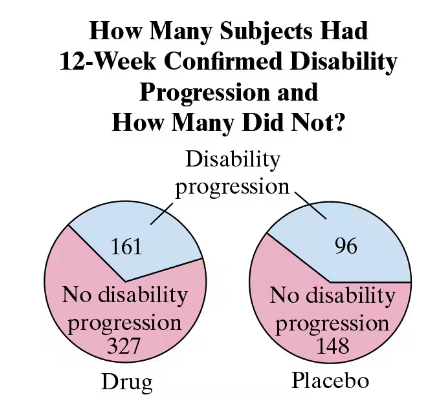
Multiple Sclerosis Drug In a study to determine the effectiveness of using a drug to treat multiple sclerosis, 488 subjects were given the drug and 244 subjects were given a placebo. The numbers of subjects who had 12-week confirmed disability progression were tracked. The results are shown at the left. At α=0.01, can you support the claim that there is a difference in the proportion of subjects who had no 12-week confirmed disability progression? (Adapted from The New England Journal of Medicine)

Verified step by step guidance1
Identify the claim and state the null hypothesis (Ho) and the alternative hypothesis (Ha). The claim is that there is a difference in the proportion of subjects who had no 12-week confirmed disability progression between the drug and placebo groups. Ho: p1 = p2 (no difference in proportions), Ha: p1 ≠ p2 (there is a difference in proportions).
Determine the significance level (α = 0.01) and find the critical value(s) for a two-tailed test. Use the standard normal distribution (z-distribution) to find the critical z-values corresponding to α/2 for each tail.
Calculate the sample proportions for each group. For the drug group, p̂1 = 327/488. For the placebo group, p̂2 = 148/244. Then, calculate the pooled proportion (p̂) using the formula: p̂ = (x1 + x2) / (n1 + n2), where x1 and x2 are the counts of successes (no disability progression) and n1 and n2 are the sample sizes.
Compute the standardized test statistic z using the formula: z = (p̂1 - p̂2) / sqrt(p̂(1 - p̂)(1/n1 + 1/n2)). Substitute the values of p̂1, p̂2, p̂, n1, and n2 into the formula to calculate z.
Compare the calculated z-value to the critical z-values to decide whether to reject or fail to reject the null hypothesis. If the z-value falls in the rejection region, reject Ho. Finally, interpret the decision in the context of the original claim: determine whether the data supports the claim that there is a difference in the proportions of subjects with no disability progression between the drug and placebo groups.
Verified video answer for a similar problem:This video solution was recommended by our tutors as helpful for the problem above
Video duration:
6mPlay a video:
Was this helpful?
Key Concepts
Here are the essential concepts you must grasp in order to answer the question correctly.
Hypothesis Testing
Hypothesis testing is a statistical method used to make decisions about a population based on sample data. It involves formulating two competing hypotheses: the null hypothesis (H0), which states there is no effect or difference, and the alternative hypothesis (Ha), which suggests there is an effect or difference. In this context, the claim is tested by comparing the proportions of subjects with and without disability progression between the drug and placebo groups.
Recommended video:
Guided course
Step 1: Write Hypotheses
Critical Value and Rejection Region
The critical value is a threshold that determines the boundary for rejecting the null hypothesis in hypothesis testing. It is derived from the significance level (α), which in this case is set at 0.01. The rejection region is the range of values for the test statistic that would lead to rejecting H0. Understanding these concepts is crucial for determining whether the observed difference in proportions is statistically significant.
Recommended video:
Critical Values: t-Distribution
Standardized Test Statistic (z)
The standardized test statistic, often denoted as z, measures how many standard deviations an observed proportion is from the expected proportion under the null hypothesis. It is calculated using the difference between sample proportions, the pooled proportion, and the standard error. This statistic helps in assessing the strength of evidence against the null hypothesis and is essential for making a decision regarding the claim about the drug's effectiveness.
Recommended video:
Guided course
Step 2: Calculate Test Statistic
Watch next
Master Difference in Proportions: Hypothesis Tests with a bite sized video explanation from Patrick
Start learningRelated Videos
Related Practice
Textbook Question
16
views