
Ch. 7 - Estimating Parameters and Determining Sample Sizes
Triola - Elementary Statistics 14th Edition
Triola14th EditionElementary StatisticsISBN: 9780137366446Not the one you use?Change textbook
Chapter 7, Problem 7.3.9

Body Temperature Data Set 5 “Body Temperatures” in Appendix B includes a sample of 106 body temperatures having a mean of and a standard deviation of 0.62F (for day 2 at 12 AM). Construct a 95% confidence interval estimate of the standard deviation of the body temperatures for the entire population.

Verified step by step guidance
1
Step 1: Understand the problem. We are tasked with constructing a 95% confidence interval for the population standard deviation (σ) based on a sample of 106 body temperatures. The sample standard deviation (s) is given as 0.62°F.
Step 2: Recall the formula for the confidence interval of the population standard deviation. The confidence interval is based on the chi-square distribution and is given by: \( \sqrt{\frac{(n-1)s^2}{\chi^2_{\text{upper}}}} \leq \sigma \leq \sqrt{\frac{(n-1)s^2}{\chi^2_{\text{lower}}}} \), where \( n \) is the sample size, \( s \) is the sample standard deviation, and \( \chi^2_{\text{upper}} \) and \( \chi^2_{\text{lower}} \) are the critical values of the chi-square distribution for the given confidence level.
Step 3: Identify the degrees of freedom (df) and the critical values. The degrees of freedom are \( df = n - 1 \), where \( n \) is the sample size. For a 95% confidence level, find the critical values \( \chi^2_{\text{lower}} \) and \( \chi^2_{\text{upper}} \) from the chi-square distribution table or using statistical software.
Step 4: Plug the values into the formula. Substitute \( n = 106 \), \( s = 0.62 \), and the critical values \( \chi^2_{\text{lower}} \) and \( \chi^2_{\text{upper}} \) into the confidence interval formula to calculate the lower and upper bounds for \( \sigma \).
Step 5: Interpret the result. The resulting interval provides a range of plausible values for the population standard deviation of body temperatures at a 95% confidence level. This means we are 95% confident that the true population standard deviation lies within this interval.

Verified video answer for a similar problem:

This video solution was recommended by our tutors as helpful for the problem above.
Video duration:
6m
Was this helpful?

Key Concepts

Here are the essential concepts you must grasp in order to answer the question correctly.

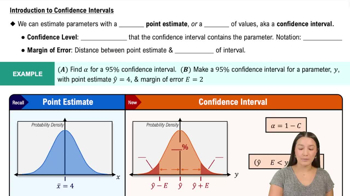
Confidence Interval

A confidence interval is a range of values, derived from a data set, that is likely to contain the true population parameter with a specified level of confidence, typically expressed as a percentage. For example, a 95% confidence interval suggests that if we were to take many samples and construct intervals in the same way, approximately 95% of those intervals would contain the true population mean or standard deviation.
Recommended video:
06:33
Introduction to Confidence Intervals

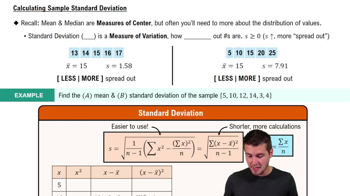
Standard Deviation

Standard deviation is a measure of the amount of variation or dispersion in a set of values. A low standard deviation indicates that the values tend to be close to the mean, while a high standard deviation indicates that the values are spread out over a wider range. In the context of the body temperature data, it helps quantify how much individual body temperatures deviate from the average temperature.
Recommended video:
Guided course
08:45
Calculating Standard Deviation

Chi-Square Distribution

The Chi-square distribution is a statistical distribution that is commonly used in hypothesis testing and constructing confidence intervals for variance and standard deviation. When estimating the standard deviation of a population from a sample, the Chi-square distribution helps determine the critical values needed to construct the confidence interval, particularly when the sample size is small or the population variance is unknown.
Recommended video:
Guided course
03:28
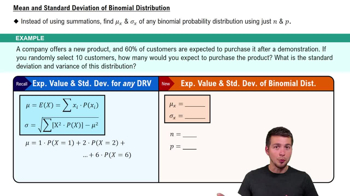
Mean & Standard Deviation of Binomial Distribution
Related Practice
Textbook Question

Large Data Sets from Appendix B. In Exercises 21 and 22, use the data set in Appendix B. Assume that each sample is a simple random sample obtained from a population with a normal distribution.


Comparing Waiting Lines Refer to Data Set 30 “Queues” in Appendix B. Construct separate 95% confidence interval estimates of using the two-line wait times and the single-line wait times. Do the results support the expectation that the single line has less variation? Do the wait times from both line configurations satisfy the requirements for confidence interval estimates of sigma

121
views
Textbook Question

Constructing and Interpreting Confidence Intervals. In Exercises 13–16, use the given sample data and confidence level. In each case, (a) find the best point estimate of the population proportion p; (b) identify the value of the margin of error E; (c) construct the confidence interval; (d) write a statement that correctly interprets the confidence interval.


Medical Malpractice In a study of 1228 randomly selected medical malpractice lawsuits, it was found that 856 of them were dropped or dismissed (based on data from the Physicians Insurers Association of America). Construct a 95% confidence interval for the proportion of medical malpractice lawsuits that are dropped or dismissed.

181
views
Textbook Question

Formats of Confidence Intervals. In Exercises 9–12, express the confidence interval using the indicated format. (The confidence intervals are based on the proportions of red, orange, yellow, and blue M&Ms in Data Set 38 “Candies” in Appendix B.)


Green M&Ms Express 0.116 < p < 0.192 in the form of p +-E.

167
views
Textbook Question

Mercury in Sushi An FDA guideline is that the mercury in fish should be below 1 part per million (ppm). Listed below are the amounts of mercury (ppm) found in tuna sushi sampled at different stores in New York City. The study was sponsored by the New York Times, and the stores (in order) are D’Agostino, Eli’s Manhattan, Fairway, Food Emporium, Gourmet Garage, Grace’s Marketplace, and Whole Foods. Construct a 98% confidence interval estimate of the mean amount of mercury in the population. Does it appear that there is too much mercury in tuna sushi?


0.56 0.75 0.10 0.95 1.25 0.54 0.88

120
views
Textbook Question

Sample Size for Proportion Find the sample size required to estimate the percentage of statistics students who take their statistics course online. Assume that we want 95% confidence that the proportion from the sample is within two percentage points of the true population percentage.

152
views
Textbook Question

Genes Samples of DNA are collected, and the four DNA bases of A, G, C, and T are coded as 1, 2, 3, and 4, respectively. The results are listed below. Construct a 95% confidence interval estimate of the mean. What is the practical use of the confidence interval?


2 2 1 4 3 3 3 3 4 1

185
views