An auto parts seller finds that 1 in every 200 parts sold is defective. Use the geometric distribution to find the probability that (c) none of the first 20 parts sold are defective.
Table of contents
- 1. Intro to Stats and Collecting Data1h 14m
- 2. Describing Data with Tables and Graphs1h 55m
- 3. Describing Data Numerically2h 5m
- 4. Probability2h 16m
- 5. Binomial Distribution & Discrete Random Variables3h 6m
- 6. Normal Distribution and Continuous Random Variables2h 11m
- 7. Sampling Distributions & Confidence Intervals: Mean3h 23m
- Sampling Distribution of the Sample Mean and Central Limit Theorem19m
- Distribution of Sample Mean - Excel23m
- Introduction to Confidence Intervals15m
- Confidence Intervals for Population Mean1h 18m
- Determining the Minimum Sample Size Required12m
- Finding Probabilities and T Critical Values - Excel28m
- Confidence Intervals for Population Means - Excel25m
- 8. Sampling Distributions & Confidence Intervals: Proportion1h 25m
- 9. Hypothesis Testing for One Sample3h 29m
- 10. Hypothesis Testing for Two Samples4h 50m
- Two Proportions1h 13m
- Two Proportions Hypothesis Test - Excel28m
- Two Means - Unknown, Unequal Variance1h 3m
- Two Means - Unknown Variances Hypothesis Test - Excel12m
- Two Means - Unknown, Equal Variance15m
- Two Means - Unknown, Equal Variances Hypothesis Test - Excel9m
- Two Means - Known Variance12m
- Two Means - Sigma Known Hypothesis Test - Excel21m
- Two Means - Matched Pairs (Dependent Samples)42m
- Matched Pairs Hypothesis Test - Excel12m
- 11. Correlation1h 24m
- 12. Regression1h 50m
- 13. Chi-Square Tests & Goodness of Fit2h 21m
- 14. ANOVA1h 57m
5. Binomial Distribution & Discrete Random Variables
Binomial Distribution
Problem 4.2.18
Textbook Question
Identifying and Understanding Binomial Experiments In Exercises 15–18, determine whether the experiment is a binomial experiment. If it is, identify a success; specify the values of n, p, and q; and list the possible values of the random variable x. If it is not a binomial experiment, explain why.
Basketball A’ja Wilson, the 2020 WNBA Most Valuable Player, makes a free throw shot about 78% of the time. The random variable represents the number of free throws that she makes on eight attempts. (Source: Women’s National Basketball Association)
Verified step by step guidance1
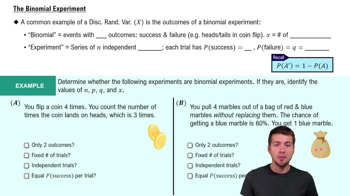
Step 1: Recall the criteria for a binomial experiment. A binomial experiment must satisfy the following conditions: (1) The experiment consists of a fixed number of trials (n). (2) Each trial has only two possible outcomes: success or failure. (3) The probability of success (p) is the same for each trial. (4) The trials are independent of each other.
Step 2: Analyze the problem to determine if it meets the criteria for a binomial experiment. In this case, the experiment involves A’ja Wilson attempting 8 free throws. Each attempt can result in either a success (making the shot) or a failure (missing the shot). The probability of success (making a free throw) is 78% (p = 0.78), and the trials are independent because the outcome of one free throw does not affect the others.
Step 3: Identify the success, n, p, and q. A success is defined as making a free throw. The number of trials (n) is 8. The probability of success (p) is 0.78, and the probability of failure (q) is 1 - p = 0.22.
Step 4: List the possible values of the random variable x. The random variable x represents the number of free throws made. Since there are 8 trials, x can take on any integer value from 0 to 8 (inclusive).
Step 5: Conclude whether this is a binomial experiment. Since the problem satisfies all four criteria for a binomial experiment, it is indeed a binomial experiment. Summarize the key parameters: n = 8, p = 0.78, q = 0.22, and x can range from 0 to 8.
Verified video answer for a similar problem:This video solution was recommended by our tutors as helpful for the problem above
Video duration:
4mPlay a video:
Was this helpful?
Key Concepts
Here are the essential concepts you must grasp in order to answer the question correctly.
Binomial Experiment
A binomial experiment is a statistical experiment that meets four criteria: it consists of a fixed number of trials, each trial has two possible outcomes (success or failure), the trials are independent, and the probability of success remains constant across trials. In this context, the experiment involves A’ja Wilson attempting free throws, where each shot can be classified as either a success (making the shot) or a failure (missing the shot).
Recommended video:
Guided course
The Binomial Experiment
Parameters n, p, and q
In a binomial experiment, 'n' represents the number of trials, 'p' is the probability of success on each trial, and 'q' is the probability of failure, which can be calculated as 1 - p. For A’ja Wilson's free throw attempts, n is 8 (the number of shots), p is 0.78 (the probability of making a shot), and q is 0.22 (the probability of missing a shot).
Recommended video:
Guided course
Parameters vs. Statistics
Random Variable x
The random variable x in a binomial experiment represents the number of successes in n trials. In this scenario, x would denote the number of successful free throws made by A’ja Wilson out of her 8 attempts. The possible values of x range from 0 to 8, indicating that she could make anywhere from none to all of her free throws.
Recommended video:
Guided course
Expected Value (Mean) of Random Variables
Watch next
Master The Binomial Experiment with a bite sized video explanation from Patrick
Start learningRelated Videos
Related Practice
Textbook Question
37
views