
Textbook Question
1. What is a residual? Explain when a residual is positive, negative, and zero.
216
views

 Verified step by step guidance
 05:43
05:43 05:43
05:43 04:39
04:391. What is a residual? Explain when a residual is positive, negative, and zero.
"[APPLET] Registered Nurse Salaries In Exercises 27–30, use the table, which shows the years of experience of 14 registered nurses and their annual salaries (in thousands of dollars). (Adapted from Payscale, Inc.)
27. Correlation Using the scatter plot of the registered nurse salary data shown below, what type of correlation, if any, do you think the data have? Explain.
"
"In Exercises 7-12, match the description in the left column with its symbol(s) in the right column.
9. Slope
a. \(\hat{y}\)_i
b. y_i
c. b
d. (\(\bar{x}\), \(\bar{y}\))
e. m
f. \(\bar{y}\)"
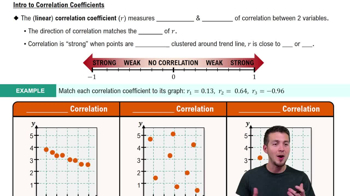
8. In your own words, what does it mean to say "correlation does not imply causation"? List a pair of variables that have correlation but no cause-and-effect relationship.
"In Exercises 9 and 10, identify the explanatory variable and the response variable.
9. A nutritionist wants to determine whether the amounts of water consumed each day by persons of the same weight and on the same diet can be used to predict individual weight
loss."
"In Exercises 7-12, match the description in the left column with its symbol(s) in the right column.
12. The point a regression line always passes through
a. \(\hat{y}\)_i
b. y_i
c. b
d. (\(\bar{x}\), \(\bar{y}\))
e. m
f. \(\bar{y}\)"