Shark Attacks Explain how the following graph is misleading.
Table of contents
- 1. Intro to Stats and Collecting Data1h 14m
- 2. Describing Data with Tables and Graphs1h 55m
- 3. Describing Data Numerically2h 5m
- 4. Probability2h 16m
- 5. Binomial Distribution & Discrete Random Variables3h 6m
- 6. Normal Distribution and Continuous Random Variables2h 11m
- 7. Sampling Distributions & Confidence Intervals: Mean3h 23m
- Sampling Distribution of the Sample Mean and Central Limit Theorem19m
- Distribution of Sample Mean - Excel23m
- Introduction to Confidence Intervals15m
- Confidence Intervals for Population Mean1h 18m
- Determining the Minimum Sample Size Required12m
- Finding Probabilities and T Critical Values - Excel28m
- Confidence Intervals for Population Means - Excel25m
- 8. Sampling Distributions & Confidence Intervals: Proportion1h 25m
- 9. Hypothesis Testing for One Sample3h 29m
- 10. Hypothesis Testing for Two Samples4h 50m
- Two Proportions1h 13m
- Two Proportions Hypothesis Test - Excel28m
- Two Means - Unknown, Unequal Variance1h 3m
- Two Means - Unknown Variances Hypothesis Test - Excel12m
- Two Means - Unknown, Equal Variance15m
- Two Means - Unknown, Equal Variances Hypothesis Test - Excel9m
- Two Means - Known Variance12m
- Two Means - Sigma Known Hypothesis Test - Excel21m
- Two Means - Matched Pairs (Dependent Samples)42m
- Matched Pairs Hypothesis Test - Excel12m
- 11. Correlation1h 24m
- 12. Regression1h 50m
- 13. Chi-Square Tests & Goodness of Fit2h 21m
- 14. ANOVA1h 57m
2. Describing Data with Tables and Graphs
Bar Graphs and Pareto Charts
Problem 2.1.11b
Textbook Question
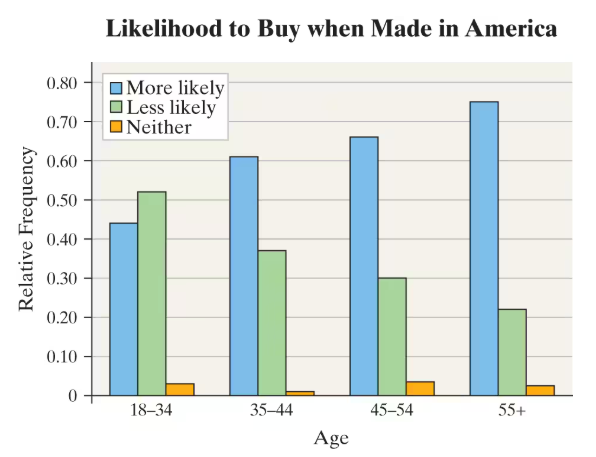
Made in America A random sample of 2163 adults (aged 18 and over) was asked, “When you see an ad emphasizing that a product is ‘Made in America,’ are you more likely to buy it, less likely to buy it, or neither more nor less likely to buy it?” The results of the survey are presented in the side-by-side bar graph. Which age group has the greatest proportion who are more likely to buy when made in America?

Verified step by step guidance1
Step 1: Understand the question. We need to find which age group has the greatest proportion of people who are 'more likely' to buy a product when it is labeled 'Made in America.' This means we focus on the 'More likely' category in the bar graph.
Step 2: Identify the 'More likely' bars in the graph. These bars are colored blue according to the legend. For each age group (18-34, 35-44, 45-54, 55+), observe the height of the blue bar, which represents the relative frequency or proportion of respondents who are more likely to buy.
Step 3: Compare the heights of the blue bars across the age groups. The taller the blue bar, the higher the proportion of people in that age group who are more likely to buy the product when it is made in America.
Step 4: Note the approximate relative frequencies from the graph for each age group’s 'More likely' category. For example, the 18-34 group has a blue bar around 0.45, 35-44 around 0.61, 45-54 around 0.66, and 55+ around 0.75.
Step 5: Conclude that the age group with the greatest proportion is the one with the highest blue bar value, which is the 55+ age group, as it has the largest relative frequency for 'More likely' to buy.
Verified video answer for a similar problem:This video solution was recommended by our tutors as helpful for the problem above
Video duration:
2mPlay a video:
Was this helpful?
Key Concepts
Here are the essential concepts you must grasp in order to answer the question correctly.
Relative Frequency
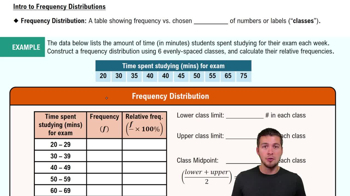
Relative frequency represents the proportion of observations within a category compared to the total number of observations. It is calculated by dividing the frequency of a specific outcome by the total sample size, allowing comparison across groups of different sizes.
Recommended video:
Guided course
Intro to Frequency Distributions
Bar Graph Interpretation
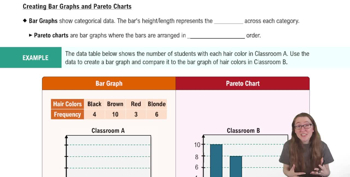
A side-by-side bar graph displays multiple categories for each group, enabling comparison of different responses within age groups. Understanding how to read the height of bars relative to the y-axis helps identify which category has the greatest proportion.
Recommended video:
Creating Bar Graphs and Pareto Charts
Proportion Comparison Across Groups
Comparing proportions across different groups involves analyzing relative frequencies to determine which group has the highest or lowest value for a specific response. This is essential for identifying trends or differences among age groups in survey data.
Recommended video:
Guided course
Difference in Proportions: Hypothesis Tests Example 1
Watch next
Master Creating Bar Graphs and Pareto Charts with a bite sized video explanation from Patrick
Start learningRelated Videos
Related Practice
Textbook Question
13
views