Most Valuable Player The following Pareto chart shows the position played by the most valuable player (MVP) in the National League since 1931. How many MVPs played first base (1B)?
Table of contents
- 1. Intro to Stats and Collecting Data1h 14m
- 2. Describing Data with Tables and Graphs1h 55m
- 3. Describing Data Numerically2h 5m
- 4. Probability2h 16m
- 5. Binomial Distribution & Discrete Random Variables3h 6m
- 6. Normal Distribution and Continuous Random Variables2h 11m
- 7. Sampling Distributions & Confidence Intervals: Mean3h 23m
- Sampling Distribution of the Sample Mean and Central Limit Theorem19m
- Distribution of Sample Mean - Excel23m
- Introduction to Confidence Intervals15m
- Confidence Intervals for Population Mean1h 18m
- Determining the Minimum Sample Size Required12m
- Finding Probabilities and T Critical Values - Excel28m
- Confidence Intervals for Population Means - Excel25m
- 8. Sampling Distributions & Confidence Intervals: Proportion1h 25m
- 9. Hypothesis Testing for One Sample3h 29m
- 10. Hypothesis Testing for Two Samples4h 50m
- Two Proportions1h 13m
- Two Proportions Hypothesis Test - Excel28m
- Two Means - Unknown, Unequal Variance1h 3m
- Two Means - Unknown Variances Hypothesis Test - Excel12m
- Two Means - Unknown, Equal Variance15m
- Two Means - Unknown, Equal Variances Hypothesis Test - Excel9m
- Two Means - Known Variance12m
- Two Means - Sigma Known Hypothesis Test - Excel21m
- Two Means - Matched Pairs (Dependent Samples)42m
- Matched Pairs Hypothesis Test - Excel12m
- 11. Correlation1h 24m
- 12. Regression1h 50m
- 13. Chi-Square Tests & Goodness of Fit2h 21m
- 14. ANOVA1h 57m
2. Describing Data with Tables and Graphs
Bar Graphs and Pareto Charts
Problem 2.1.13e
Textbook Question
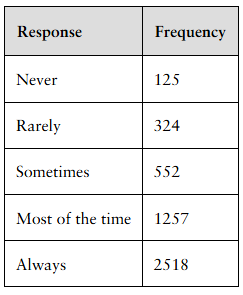
College Survey In a national survey conducted by the Centers for Disease Control to determine health-risk behaviors among college students, college students were asked, “How often do you wear a seat belt when riding in a car driven by someone else?” The frequencies were as follows:

e. Construct a relative frequency bar graph.
Verified step by step guidance1
Step 1: Calculate the total number of responses by summing all the frequencies: \$125 + 324 + 552 + 1257 + 2518$.
Step 2: Compute the relative frequency for each response category by dividing the frequency of each category by the total number of responses. For example, for 'Never', the relative frequency is \(\frac{125}{\text{total}}\).
Step 3: Repeat the calculation for each category: 'Rarely', 'Sometimes', 'Most of the time', and 'Always', using the formula \(\text{Relative Frequency} = \frac{\text{Frequency}}{\text{Total}}\).
Step 4: Create a bar graph where the x-axis represents the response categories and the y-axis represents the relative frequencies. Each bar's height corresponds to the relative frequency of that category.
Step 5: Label the axes clearly, provide a title for the graph, and ensure the relative frequencies are displayed as proportions or percentages to make the graph easy to interpret.
Verified video answer for a similar problem:This video solution was recommended by our tutors as helpful for the problem above
Video duration:
5mPlay a video:
Was this helpful?
Key Concepts
Here are the essential concepts you must grasp in order to answer the question correctly.
Frequency and Relative Frequency
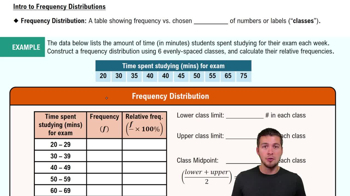
Frequency refers to the count of how often a particular response or event occurs in a dataset. Relative frequency is the proportion of the total observations that a specific category represents, calculated by dividing the frequency of the category by the total number of observations. It helps compare categories on a common scale.
Recommended video:
Guided course
Intro to Frequency Distributions
Bar Graph Construction
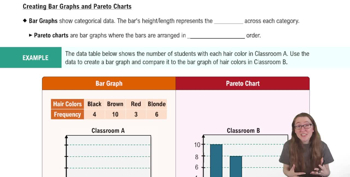
A bar graph visually represents categorical data with rectangular bars, where the length of each bar corresponds to the frequency or relative frequency of each category. For relative frequency bar graphs, the y-axis shows proportions or percentages, making it easier to compare categories regardless of sample size.
Recommended video:
Creating Bar Graphs and Pareto Charts
Data Interpretation in Surveys
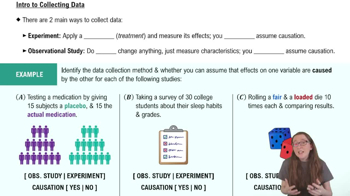
Understanding survey data involves recognizing how responses are categorized and summarized. Interpreting frequencies and relative frequencies helps identify patterns or trends in behavior, such as seat belt usage among college students, which can inform public health decisions or further analysis.
Recommended video:
Introduction to Collecting Data
Watch next
Master Creating Bar Graphs and Pareto Charts with a bite sized video explanation from Patrick
Start learningRelated Videos
Related Practice
Textbook Question
5
views