Ch. 7 - Hypothesis Testing with One Sample
Larson - Elementary Statistics: Picturing the World 8th Edition
Larson8th EditionElementary Statistics: Picturing the WorldISBN: 9780137493470Not the one you use?Change textbook
Chapter 7, Problem 7.5.3

How do the critical values for a two-tailed test change as alpha decreases?

Verified step by step guidance
1
Understand the concept of alpha (α): Alpha represents the significance level of a hypothesis test, which is the probability of rejecting the null hypothesis when it is actually true. Common values for alpha are 0.05, 0.01, etc.
Recognize the relationship between alpha and critical values: In a two-tailed test, the critical values define the boundaries of the rejection region. As alpha decreases, the rejection region becomes smaller, meaning the critical values move further away from the center of the distribution.
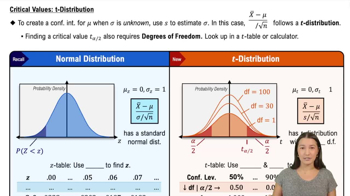
Recall the distribution used: For most hypothesis tests, the critical values are determined using a standard normal (Z) distribution or a t-distribution, depending on the sample size and whether the population standard deviation is known.
Determine the new critical values: To find the critical values for a smaller alpha, calculate the z-scores or t-scores that correspond to the new alpha level. For a two-tailed test, divide alpha by 2 to account for both tails, and then find the values that leave the remaining probability in the center of the distribution.
Interpret the change: As alpha decreases, the critical values become more extreme (larger in magnitude for positive and negative values), indicating that it becomes harder to reject the null hypothesis because the rejection region is smaller.

Verified video answer for a similar problem:

This video solution was recommended by our tutors as helpful for the problem above.
Video duration:
1m
Was this helpful?

Key Concepts

Here are the essential concepts you must grasp in order to answer the question correctly.

Critical Values

Critical values are the threshold points that define the boundaries for rejecting the null hypothesis in hypothesis testing. In a two-tailed test, critical values are determined based on the significance level (alpha) and the distribution of the test statistic. They mark the points beyond which the test statistic is considered extreme enough to reject the null hypothesis.
Recommended video:
05:50
Critical Values: t-Distribution

Alpha Level (α)

The alpha level, often denoted as α, represents the probability of making a Type I error, which occurs when the null hypothesis is incorrectly rejected. Common alpha levels are 0.05, 0.01, and 0.10. As alpha decreases, the criteria for rejecting the null hypothesis become stricter, leading to a higher threshold for critical values.
Recommended video:
04:46
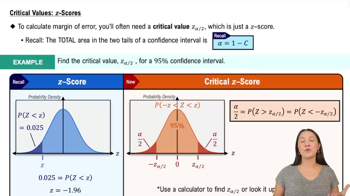
Critical Values: z Scores

Two-Tailed Test

A two-tailed test is a statistical test that evaluates whether a sample mean is significantly different from a population mean in either direction (greater or less). This type of test is used when the alternative hypothesis does not specify a direction of the effect. As alpha decreases, the critical values move further from the mean, reflecting the need for stronger evidence to reject the null hypothesis.
Recommended video:
Guided course
09:27
Difference in Proportions: Hypothesis Tests
Related Practice
Textbook Question

Stating Hypotheses In Exercises 11–16, the statement represents a claim. Write its complement and state which is H0 and which is Ha.


μ ≤ 645

64
views

Textbook Question

Identifying Type I and Type II Errors In Exercises 31–36, describe type I and type II errors for a hypothesis test of the indicated claim.


Chess A local chess club claims that the length of time to play a game has a standard deviation of more than 12 minutes.

89
views
Textbook Question

True or False? In Exercises 5–10, determine whether the statement is true or false. If it is false, rewrite it as a true statement.


A large P-value in a test will favor rejection of the null hypothesis.

88
views
Textbook Question

In Exercises 7–12, find the critical value(s) and rejection region(s) for the type of chi-square test with sample size n and level of significance α.


Right-tailed test, n=10,α=0.10

110
views
Textbook Question

Stating the Null and Alternative Hypotheses In Exercises 25–30, write the claim as a mathematical statement. State the null and alternative hypotheses, and identify which represents the claim.


Base Price of an ATV The standard deviation of the base price of an all-terrain vehicle is no more than \$320.

89
views
Textbook Question

Hypothesis Testing Using Rejection Region(s) In Exercises 39–44, (a) identify the claim and state H0 and Ha, (b) find the critical value(s) and identify the rejection region(s), (c) find the standardized test statistic z, (d) decide whether to reject or fail to reject the null hypothesis, and (e) interpret the decision in the context of the original claim.


[APPLET] Gross Domestic Product A politician estimates that the mean gross domestic product (GDP) per country in a recent year is greater than \$400 billion. You want to test this estimate. To do so, you determine the GDPs of 42 randomly selected countries for that year. The results (in billions of dollars) are shown in the table at the left. Assume the population standard deviation is \$2099 billion. At alpha=0.06, can you support the politician’s estimate?


64
views