
Textbook Question
In Exercises 1–4, classify the two samples as independent or dependent and justify your answer.
Sample 1: The retail prices of 20 motorcycles
Sample 2: The retail prices of 20 minivans
55
views

 Verified step by step guidance
 06:28
06:28
 05:11
05:11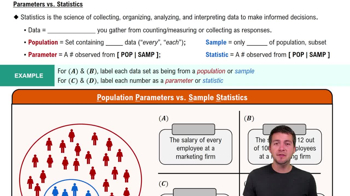 05:53
05:53In Exercises 1–4, classify the two samples as independent or dependent and justify your answer.
Sample 1: The retail prices of 20 motorcycles
Sample 2: The retail prices of 20 minivans
Take this quiz as you would take a quiz in class. After you are done, check your work against the answers given in the back of the book.For each exercise, perform the steps below.
f. Interpret the decision in the context of the original claim.
The mean score on a reading assessment test for 49 randomly selected male high school students was 279. Assume the population standard deviation is 41. The mean score on the same test for 50 randomly selected female high school students was 292. Assume the population standard deviation is 39. At α=0.05, can you support the claim that the mean score on the reading assessment test for male high school students is less than the mean score for female high school students? (Adapted from National Center for Education Statistics)
In Exercises 9 and 10, (a) identify the claim and state Ho and Ha , (b) find the critical value(s) and identify the rejection region(s), (c) find the standardized test statistic z, (d) decide whether to reject or fail to reject the null hypothesis, and (e) interpret the decision in the context of the original claim. Assume the samples are random and independent, and the populations are normally distributed.
A researcher claims that the mean sodium content of sandwiches at Restaurant A is less than the mean sodium content of sandwiches at Restaurant B. The mean sodium content of 22 randomly selected sandwiches at Restaurant A is 670 milligrams. Assume the population standard deviation is 20 milligrams. The mean sodium content of 28 randomly selected sandwiches at Restaurant B is 690 milligrams. Assume the population standard deviation is 30 milligrams. At α=0.05, is there enough evidence to support the claim?
In Exercises 5–8, test the claim about the difference between two population means μ1 and μ2 at the level of significance α. Assume the samples are random and independent, and the populations are normally distributed.
Claim: μ1>μ2; α=0.05
Population statistics: σ1= 0.30 and σ2= 0.23
Sample statistics: x̅1 = 1.28, n1 = 96, and x̅2= 1.34, n2= 85
Take this quiz as you would take a quiz in class. After you are done, check your work against the answers given in the back of the book.For each exercise, perform the steps below.
a. Identify the claim and state Ho and Ha
The mean score on a reading assessment test for 49 randomly selected male high school students was 279. Assume the population standard deviation is 41. The mean score on the same test for 50 randomly selected female high school students was 292. Assume the population standard deviation is 39. (Adapted from National Center for Education Statistics)
In Exercises 29 and 30, (a) identify the claim and state Ho and Ha, (b) find the critical value(s) and identify the rejection region(s), (c) find the standardized test statistic z, (d) decide whether to reject or fail to reject the null hypothesis, and (e) interpret the decision in the context of the original claim. Assume the samples are random and independent.
A medical research team conducted a study to test the effect of a drug used to treat a type of inflammation. In the study, 68 subjects took the drug and 68 subjects took a placebo. The results are shown below. At α=0.05, can you reject the claim that the proportion of subjects who had at least 24 weeks of accrued remission is the same for the two groups? (Source: The New England Journal of Medicine)