Birth Weights Babies born after a gestation period of 32–35 weeks have a mean weight of 2600 grams and a standard deviation of 660 grams. Babies born after a gestation period of 40 weeks have a mean weight of 3500 grams and a standard deviation of 470 grams. Suppose a 34-week gestation period baby weighs 3000 grams and a 40-week gestation period baby weighs 3900 grams. What is the z-score for the 34-week gestation period baby? What is the z-score for the 40-week gestation period baby? Which baby weighs less relative to the gestation period?
Table of contents
- 1. Intro to Stats and Collecting Data1h 14m
- 2. Describing Data with Tables and Graphs1h 55m
- 3. Describing Data Numerically2h 5m
- 4. Probability2h 16m
- 5. Binomial Distribution & Discrete Random Variables3h 6m
- 6. Normal Distribution and Continuous Random Variables2h 11m
- 7. Sampling Distributions & Confidence Intervals: Mean3h 23m
- Sampling Distribution of the Sample Mean and Central Limit Theorem19m
- Distribution of Sample Mean - Excel23m
- Introduction to Confidence Intervals15m
- Confidence Intervals for Population Mean1h 18m
- Determining the Minimum Sample Size Required12m
- Finding Probabilities and T Critical Values - Excel28m
- Confidence Intervals for Population Means - Excel25m
- 8. Sampling Distributions & Confidence Intervals: Proportion1h 25m
- 9. Hypothesis Testing for One Sample3h 29m
- 10. Hypothesis Testing for Two Samples4h 50m
- Two Proportions1h 13m
- Two Proportions Hypothesis Test - Excel28m
- Two Means - Unknown, Unequal Variance1h 3m
- Two Means - Unknown Variances Hypothesis Test - Excel12m
- Two Means - Unknown, Equal Variance15m
- Two Means - Unknown, Equal Variances Hypothesis Test - Excel9m
- Two Means - Known Variance12m
- Two Means - Sigma Known Hypothesis Test - Excel21m
- Two Means - Matched Pairs (Dependent Samples)42m
- Matched Pairs Hypothesis Test - Excel12m
- 11. Correlation1h 24m
- 12. Regression1h 50m
- 13. Chi-Square Tests & Goodness of Fit2h 21m
- 14. ANOVA1h 57m
3. Describing Data Numerically
Standard Deviation
Problem 3.2.17
Textbook Question
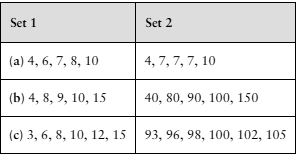
For each of the following data sets, decide which has the higher standard deviation (set 1 or set 2), if any, without doing any computation. Explain the rationale behind your choice. Then, verify your choice by computing the standard deviation by hand.

Verified step by step guidance1
Step 1: Understand the concept of standard deviation. Standard deviation measures the spread or variability of a data set around its mean. A higher standard deviation means the data points are more spread out from the mean, while a lower standard deviation means they are closer to the mean.
Step 2: Compare the data sets qualitatively without calculation. Look at the range (difference between the maximum and minimum values) and how the values are distributed:
- For (a), Set 1 has values 4, 6, 7, 8, 10 and Set 2 has 4, 7, 7, 7, 10. Set 2 has repeated values clustered around 7, so it likely has less spread.
- For (b), Set 1 has values 4, 8, 9, 10, 15 and Set 2 has 40, 80, 90, 100, 150. Set 2 has much larger values and a wider range, so it likely has a higher standard deviation.
- For (c), Set 1 has 3, 6, 8, 10, 12, 15 and Set 2 has 93, 96, 98, 100, 102, 105. Both have similar ranges, but Set 1's values are more spread out, while Set 2's values are closer together.
Step 3: Calculate the mean for each data set using the formula:
\[\text{Mean} = \frac{\sum x_i}{n}\]
where \(x_i\) are the data points and \(n\) is the number of points.
Step 4: Calculate the variance for each data set using the formula:
\[\text{Variance} = \frac{\sum (x_i - \text{Mean})^2}{n}\]
This measures the average squared deviation from the mean.
Step 5: Calculate the standard deviation by taking the square root of the variance:
\[\text{Standard Deviation} = \sqrt{\text{Variance}}\]
Compare the computed standard deviations to verify which set has the higher spread.
Verified video answer for a similar problem:This video solution was recommended by our tutors as helpful for the problem above
Video duration:
3mPlay a video:
Was this helpful?
Key Concepts
Here are the essential concepts you must grasp in order to answer the question correctly.
Standard Deviation
Standard deviation measures the amount of variation or dispersion in a data set. A higher standard deviation indicates that data points are spread out further from the mean, while a lower standard deviation means they are closer to the mean. It is calculated as the square root of the average squared deviations from the mean.
Recommended video:
Guided course
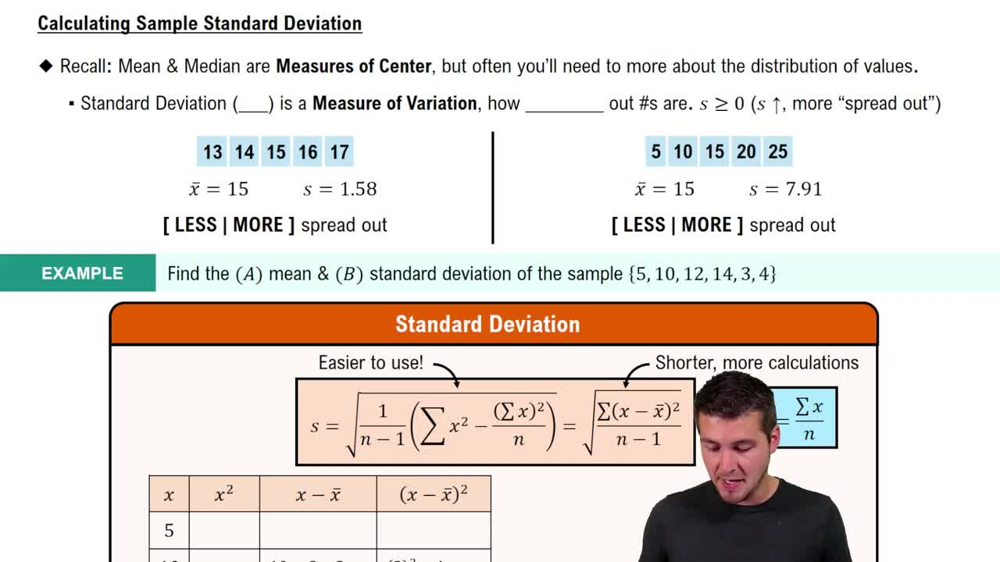
Calculating Standard Deviation
Range and Data Spread
The range, the difference between the maximum and minimum values, gives a quick sense of data spread. Generally, a larger range suggests a higher standard deviation, but the distribution of values also matters. Clusters or repeated values can reduce variability even if the range is large.
Recommended video:
Introduction to Collecting Data
Effect of Repeated Values on Variability
Repeated or identical values in a data set reduce variability because they contribute less to the overall spread around the mean. For example, a set with many repeated middle values will have a lower standard deviation than a set with more evenly spread values, even if their ranges are similar.
Recommended video:
Guided course
Expected Value (Mean) of Random Variables
Watch next
Master Calculating Standard Deviation with a bite sized video explanation from Patrick
Start learningRelated Videos
Related Practice
Textbook Question
3
views