Quality Control A manufacturer of bolts has a qualitycontrol policy that requires it to destroy any bolts that are more than 2 standard deviations from the mean. The quality-control engineer knows that the bolts coming off the assembly line have a mean length of 8 cm with a standard deviation of 0.05 cm. For what lengths will a bolt be destroyed? 167
Table of contents
- 1. Intro to Stats and Collecting Data1h 14m
- 2. Describing Data with Tables and Graphs1h 55m
- 3. Describing Data Numerically2h 5m
- 4. Probability2h 16m
- 5. Binomial Distribution & Discrete Random Variables3h 6m
- 6. Normal Distribution and Continuous Random Variables2h 11m
- 7. Sampling Distributions & Confidence Intervals: Mean3h 23m
- Sampling Distribution of the Sample Mean and Central Limit Theorem19m
- Distribution of Sample Mean - Excel23m
- Introduction to Confidence Intervals15m
- Confidence Intervals for Population Mean1h 18m
- Determining the Minimum Sample Size Required12m
- Finding Probabilities and T Critical Values - Excel28m
- Confidence Intervals for Population Means - Excel25m
- 8. Sampling Distributions & Confidence Intervals: Proportion1h 25m
- 9. Hypothesis Testing for One Sample3h 29m
- 10. Hypothesis Testing for Two Samples4h 50m
- Two Proportions1h 13m
- Two Proportions Hypothesis Test - Excel28m
- Two Means - Unknown, Unequal Variance1h 3m
- Two Means - Unknown Variances Hypothesis Test - Excel12m
- Two Means - Unknown, Equal Variance15m
- Two Means - Unknown, Equal Variances Hypothesis Test - Excel9m
- Two Means - Known Variance12m
- Two Means - Sigma Known Hypothesis Test - Excel21m
- Two Means - Matched Pairs (Dependent Samples)42m
- Matched Pairs Hypothesis Test - Excel12m
- 11. Correlation1h 24m
- 12. Regression1h 50m
- 13. Chi-Square Tests & Goodness of Fit2h 21m
- 14. ANOVA1h 57m
3. Describing Data Numerically
Standard Deviation
Problem 3.2.20b
Textbook Question
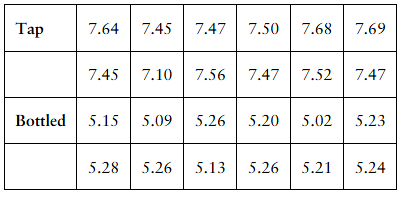
pH in Water The acidity or alkalinity of a solution is measured using pH. A pH less than 7 is acidic, while a pH greater than 7 is alkaline. The following data represent the pH in samples of bottled water and tap water. b. Which type of water has more dispersion in pH using the standard deviation as the measure of dispersion?

Verified step by step guidance1
Step 1: Organize the data for each type of water separately. For Tap water, list all the pH values: 7.64, 7.45, 7.47, 7.50, 7.68, 7.69, 7.45, 7.10, 7.56, 7.47, 7.52, 7.47. For Bottled water, list all the pH values: 5.15, 5.09, 5.26, 5.20, 5.02, 5.23, 5.28, 5.26, 5.13, 5.26, 5.21, 5.24.
Step 2: Calculate the mean (average) pH for each type of water. Use the formula for the mean: \(\text{mean} = \frac{\sum x_i}{n}\), where \(x_i\) are the pH values and \(n\) is the number of values.
Step 3: Calculate the variance for each type of water. The variance formula is \(s^2 = \frac{1}{n-1} \sum (x_i - \bar{x})^2\), where \(\bar{x}\) is the mean calculated in Step 2, and \(n\) is the number of observations.
Step 4: Calculate the standard deviation for each type of water by taking the square root of the variance: \(s = \sqrt{s^2}\). This gives a measure of dispersion of the pH values around the mean.
Step 5: Compare the standard deviations of the Tap water and Bottled water samples. The water type with the larger standard deviation has more dispersion in pH values.
Verified video answer for a similar problem:This video solution was recommended by our tutors as helpful for the problem above
Video duration:
5mPlay a video:
Was this helpful?
Key Concepts
Here are the essential concepts you must grasp in order to answer the question correctly.
Standard Deviation
Standard deviation measures the amount of variation or dispersion in a set of data values. A low standard deviation indicates that data points are close to the mean, while a high standard deviation shows data are spread out over a wider range. It is useful for comparing variability between different datasets.
Recommended video:
Guided course
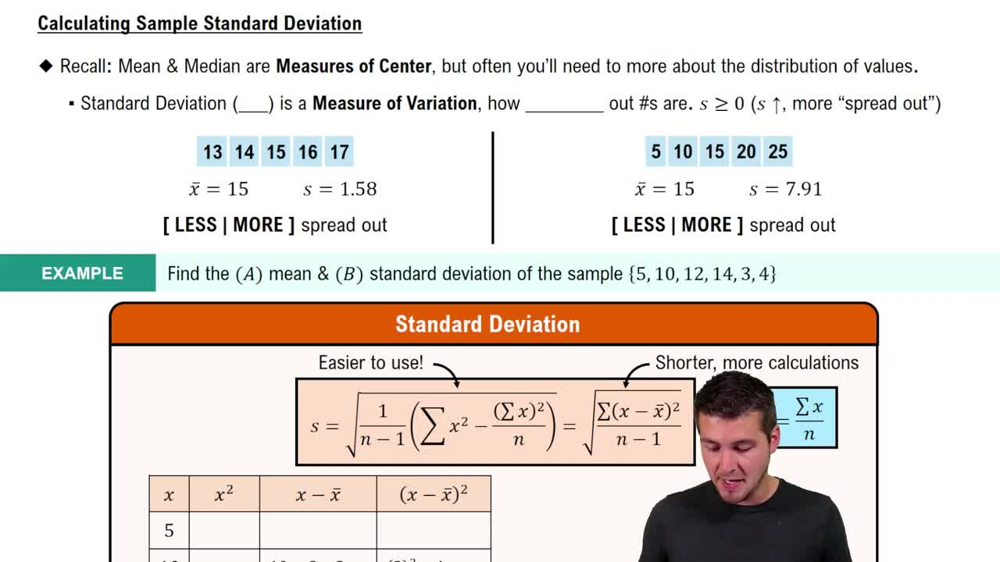
Calculating Standard Deviation
pH Scale and Its Interpretation
The pH scale ranges from 0 to 14 and measures the acidity or alkalinity of a solution. Values below 7 indicate acidity, values above 7 indicate alkalinity, and 7 is neutral. Understanding pH helps contextualize the data and the significance of differences in water samples.
Recommended video:
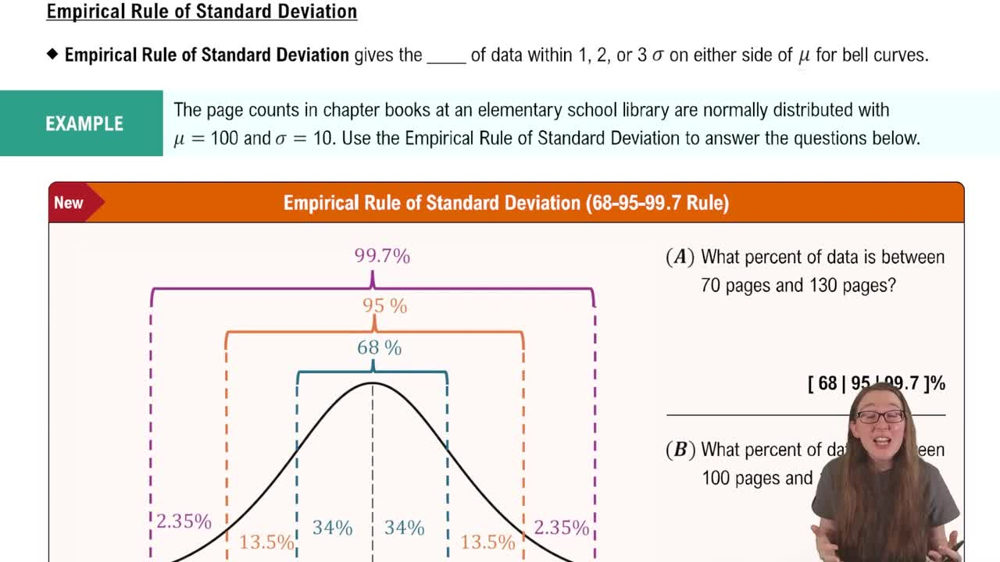
Empirical Rule of Standard Deviation and Range Rule of Thumb
Comparing Dispersion Between Groups
Comparing dispersion involves analyzing measures like standard deviation to determine which group has more variability. In this case, comparing the standard deviations of pH values for tap and bottled water reveals which type has more inconsistent pH levels.
Recommended video:
Guided course
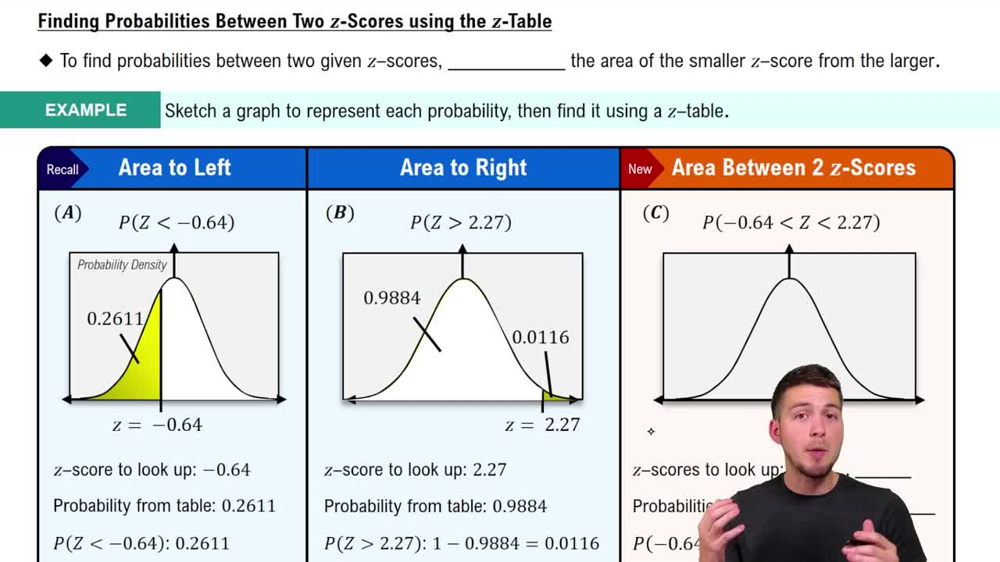
Probabilities Between Two Values
Watch next
Master Calculating Standard Deviation with a bite sized video explanation from Patrick
Start learningRelated Videos
Related Practice
Textbook Question
5
views