In Problems 11–18, find the value of each permutation. 9P4
Verified step by step guidance
1
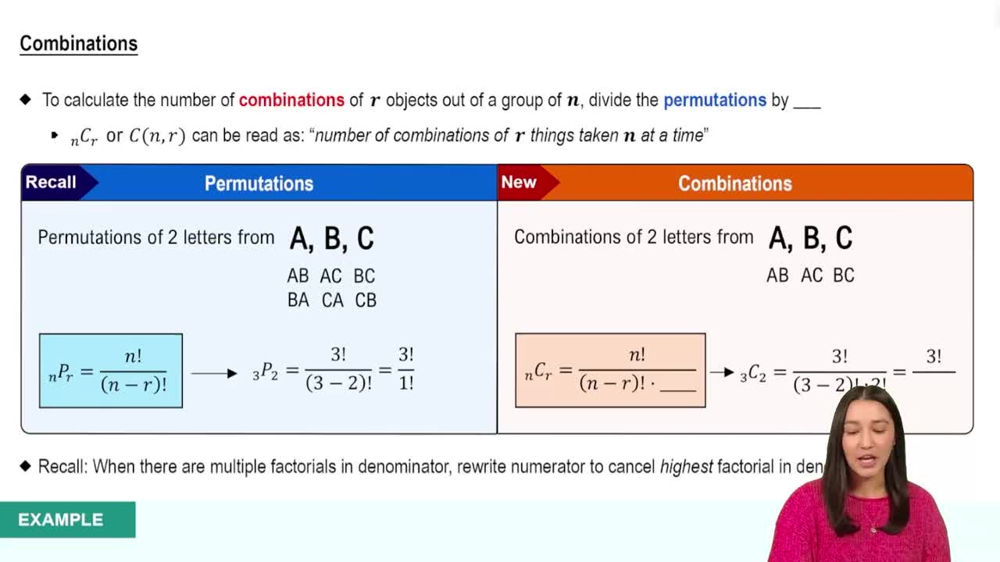
Understand that the notation \(nP r\) represents the number of permutations of \(n\) items taken \(r\) at a time, where order matters.
Recall the formula for permutations: \(nP r = \frac{n!}{(n - r)!}\), where \(n!\) denotes the factorial of \(n\).
Identify the values from the problem: here, \(n = 9\) and \(r = 4\).
Substitute these values into the formula: \(9P4 = \frac{9!}{(9 - 4)!} = \frac{9!}{5!}\).
Calculate the factorial expressions or simplify by expanding the numerator and denominator to find the number of permutations.
Verified video answer for a similar problem:
This video solution was recommended by our tutors as helpful for the problem above
Video duration:
1m
Play a video:
0 Comments
Key Concepts
Here are the essential concepts you must grasp in order to answer the question correctly.
Permutation
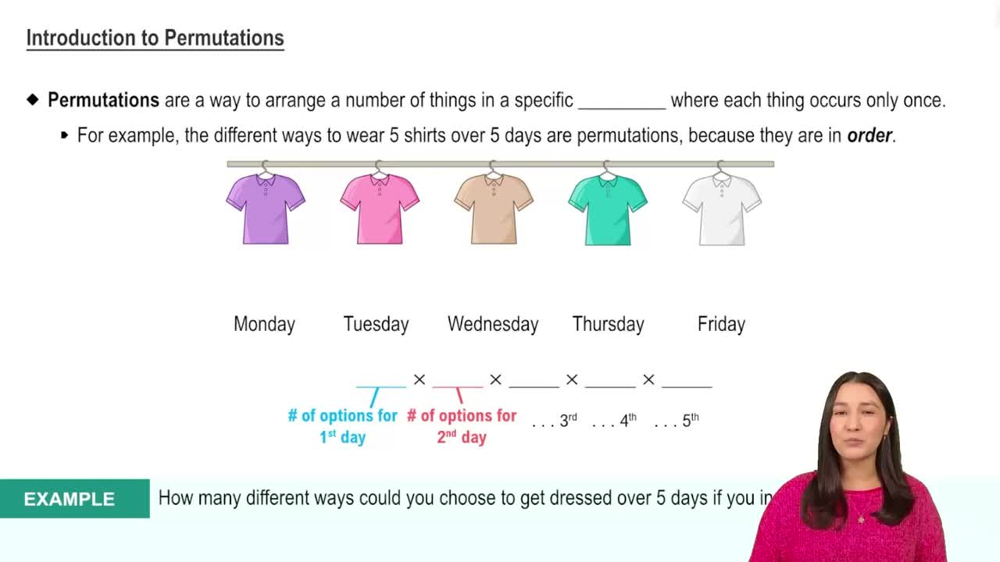
A permutation refers to the arrangement of objects in a specific order. It counts the number of ways to order a subset of items from a larger set, where order matters. For example, arranging 4 books out of 9 in a row is a permutation problem.
The permutation formula is given by nPr = n! / (n - r)!, where n is the total number of items and r is the number of items to arrange. This formula calculates the number of ordered arrangements of r items selected from n.
Factorial, denoted by n!, is the product of all positive integers up to n. It is used in permutations to calculate the total number of ways to arrange items. For example, 5! = 5 × 4 × 3 × 2 × 1 = 120.

 1:41 minutes
 Verified step by step guidance
 07:11
07:11