
Which of the following accurately describes the test for independence?
Table of contents
- 1. Intro to Stats and Collecting Data1h 14m
- 2. Describing Data with Tables and Graphs1h 55m
- 3. Describing Data Numerically2h 5m
- 4. Probability2h 16m
- 5. Binomial Distribution & Discrete Random Variables3h 6m
- 6. Normal Distribution and Continuous Random Variables2h 11m
- 7. Sampling Distributions & Confidence Intervals: Mean3h 23m
- Sampling Distribution of the Sample Mean and Central Limit Theorem19m
- Distribution of Sample Mean - Excel23m
- Introduction to Confidence Intervals15m
- Confidence Intervals for Population Mean1h 18m
- Determining the Minimum Sample Size Required12m
- Finding Probabilities and T Critical Values - Excel28m
- Confidence Intervals for Population Means - Excel25m
- 8. Sampling Distributions & Confidence Intervals: Proportion1h 25m
- 9. Hypothesis Testing for One Sample3h 29m
- 10. Hypothesis Testing for Two Samples4h 50m
- Two Proportions1h 13m
- Two Proportions Hypothesis Test - Excel28m
- Two Means - Unknown, Unequal Variance1h 3m
- Two Means - Unknown Variances Hypothesis Test - Excel12m
- Two Means - Unknown, Equal Variance15m
- Two Means - Unknown, Equal Variances Hypothesis Test - Excel9m
- Two Means - Known Variance12m
- Two Means - Sigma Known Hypothesis Test - Excel21m
- Two Means - Matched Pairs (Dependent Samples)42m
- Matched Pairs Hypothesis Test - Excel12m
- 11. Correlation1h 24m
- 12. Regression1h 50m
- 13. Chi-Square Tests & Goodness of Fit2h 21m
- 14. ANOVA1h 57m
13. Chi-Square Tests & Goodness of Fit
Independence Tests
Problem 10.2.4
Textbook Question
Explain why the chi-square independence test is always a right-tailed test.
Verified step by step guidance1
The chi-square independence test is used to determine whether there is a significant association between two categorical variables. The test statistic is calculated based on the differences between observed and expected frequencies in a contingency table.
The chi-square test statistic formula is: , where Oᵢ represents the observed frequency and Eᵢ represents the expected frequency for each cell in the table.
The chi-square distribution is inherently non-negative because the test statistic involves squaring the differences between observed and expected frequencies. This ensures that the test statistic is always greater than or equal to zero.
In hypothesis testing, the null hypothesis assumes no association between the variables, meaning the observed frequencies are close to the expected frequencies. Large values of the chi-square statistic indicate greater deviations from the null hypothesis, suggesting a stronger association between the variables.
Since we are interested in detecting significant deviations from the null hypothesis (large chi-square values), the chi-square independence test is always conducted as a right-tailed test, where the critical region lies in the upper tail of the chi-square distribution.
Verified video answer for a similar problem:This video solution was recommended by our tutors as helpful for the problem above
Video duration:
3mPlay a video:
Was this helpful?
Key Concepts
Here are the essential concepts you must grasp in order to answer the question correctly.
Chi-Square Test
The chi-square test is a statistical method used to determine if there is a significant association between categorical variables. It compares the observed frequencies in each category to the frequencies expected under the null hypothesis of independence. The test statistic follows a chi-square distribution, which is crucial for interpreting the results.
Recommended video:
Guided course
Intro to Least Squares Regression
Null Hypothesis
In hypothesis testing, the null hypothesis represents a statement of no effect or no association between variables. For the chi-square independence test, the null hypothesis posits that the two categorical variables are independent of each other. The goal of the test is to assess whether the observed data provides sufficient evidence to reject this null hypothesis.
Recommended video:
Guided course
Step 1: Write Hypotheses
Right-Tailed Test
A right-tailed test is a type of hypothesis test where the critical region for rejecting the null hypothesis is located in the right tail of the distribution. In the context of the chi-square independence test, if the test statistic is significantly large, it indicates a strong association between the variables, leading to rejection of the null hypothesis. This is why the chi-square test is always right-tailed, as it assesses whether the observed frequencies deviate significantly from the expected frequencies in a positive direction.
Recommended video:
Guided course
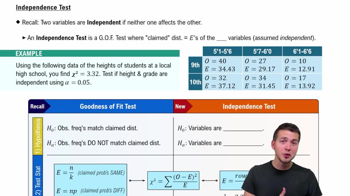
Independence Test
Related Videos
Related Practice
Multiple Choice
15
views
