Ch. 2 - Descriptive Statistics
Larson - Elementary Statistics: Picturing the World 8th Edition
Larson8th EditionElementary Statistics: Picturing the WorldISBN: 9780137493470Not the one you use?Change textbook
Chapter 2, Problem 2.2.40

Extending Concepts


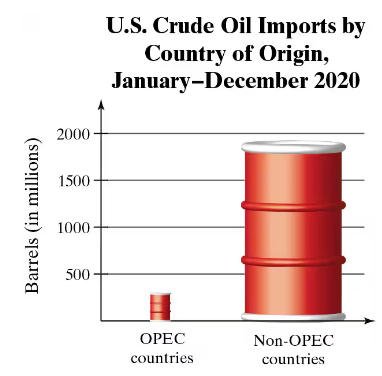
A Misleading Graph? A misleading graph is not drawn appropriately, which can misrepresent data and lead to false conclusions. In Exercises 37–40, (a) explain why the graph is misleading, and (b) redraw the graph so that it is not misleading.


bar1

Verified step by step guidance
1
Analyze the graph: The graph compares U.S. crude oil imports from OPEC countries and non-OPEC countries using barrel icons. The size of the barrels is disproportionate to the actual data values, which can visually exaggerate the difference between the two categories.
Explain why the graph is misleading: The barrel icons are scaled in both height and width, making the visual difference appear much larger than the actual numerical difference. This violates the principle of proportional representation in graphs, as the area of the barrels does not correspond to the data values.
Redraw the graph: To make the graph accurate, use a standard bar graph where the height of the bars is proportional to the data values. Ensure that the y-axis is labeled clearly and scaled appropriately to represent the range of values.
Label the axes and provide context: Clearly label the x-axis with 'Country of Origin' and the y-axis with 'Barrels (in millions).' Include a title that accurately describes the data, such as 'U.S. Crude Oil Imports by Country of Origin, 2020.'
Verify proportionality: Ensure that the visual representation of the data (e.g., bar heights) matches the numerical values provided. This will prevent misinterpretation and allow viewers to draw accurate conclusions from the graph.

Verified video answer for a similar problem:

This video solution was recommended by our tutors as helpful for the problem above.
Video duration:
1m
Was this helpful?

Key Concepts

Here are the essential concepts you must grasp in order to answer the question correctly.

Misleading Graphs

A misleading graph is one that presents data in a way that can distort the truth or lead to incorrect interpretations. This can occur through inappropriate scaling, selective data presentation, or visual exaggeration. For instance, if the height of bars in a bar graph is not proportional to the values they represent, it can mislead viewers about the actual differences between categories.
Recommended video:
04:13
Creating Time-Series Graphs

Bar Graphs

Bar graphs are visual representations of data that use rectangular bars to show the quantity of different categories. The length or height of each bar corresponds to the value it represents, making it easy to compare different groups. Properly designed bar graphs should have consistent scales and clear labels to ensure accurate interpretation of the data.
Recommended video:
04:52
Creating Bar Graphs and Pareto Charts

Data Representation

Data representation refers to the methods used to visually display data, which can significantly influence how information is perceived. Effective data representation should accurately reflect the underlying data without distortion. This includes using appropriate scales, maintaining proportionality, and ensuring clarity, which helps viewers draw valid conclusions from the presented information.
Recommended video:
4:01
Introduction to Collecting Data