
Waiting in LineOne aspect of queuing theory is to consider waiting time in lines. A fast-food chain is trying to determine whether it should switch from having four cash registers with four separate lines to four cash registers with a single line. It has been determined that the mean wait-time in both lines is equal. However, the chain is uncertain about which line has less variability in wait time. From experience, the chain knows that the wait times in the four separate lines are normally distributed with σ = 1.2 minutes. In a study, the chain reconfigured five restaurants to have a single line and measured the wait times for 50 randomly selected customers. The sample standard deviation was determined to be s = 0.84 minute. Is the variability in wait time less for a single line than for multiple lines at the α = 0.05 level of significance?
9. Hypothesis Testing for One Sample
Steps in Hypothesis Testing
 1:24 minutes
Problem 10.R.19
Textbook Question
Explain the difference between “accepting” and “not rejecting” a null hypothesis.
 Verified step by step guidance
1
Understand that in hypothesis testing, the null hypothesis (denoted as \(H_0\)) represents a default or status quo assumption that we test against an alternative hypothesis (\(H_a\)).
Recognize that "rejecting the null hypothesis" means the data provides sufficient evidence to conclude that \(H_0\) is unlikely to be true, so we accept the alternative hypothesis.
Know that "not rejecting the null hypothesis" means the data does not provide strong enough evidence to reject \(H_0\), but this does not prove \(H_0\) is true; it simply means we do not have enough evidence against it.
Understand that "accepting the null hypothesis" is a stronger statement implying \(H_0\) is true, which is generally avoided in statistics because failing to reject \(H_0\) does not confirm its truth.
Summarize that the key difference is that "not rejecting" \(H_0\) is a cautious conclusion due to insufficient evidence, while "accepting" \(H_0\) incorrectly suggests proof of its truth.
Verified video answer for a similar problem:This video solution was recommended by our tutors as helpful for the problem above

Video duration:
1mKey Concepts
Here are the essential concepts you must grasp in order to answer the question correctly.
Null Hypothesis (H0)
The null hypothesis is a default assumption that there is no effect or difference in a population. It serves as the starting point for statistical testing, where evidence is gathered to determine if it can be rejected in favor of an alternative hypothesis.
Recommended video:
Guided course

 06:21
06:21
Step 1: Write Hypotheses
Rejecting the Null Hypothesis
Rejecting the null hypothesis occurs when the sample data provides strong evidence against H0, typically when the p-value is below a chosen significance level. This suggests that the observed effect is unlikely due to chance alone.
Recommended video:
 05:52
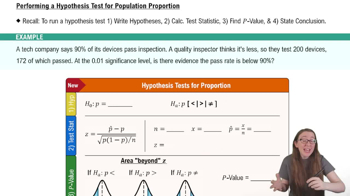
05:52Performing Hypothesis Tests: Proportions
Accepting vs. Not Rejecting the Null Hypothesis
Not rejecting the null means there is insufficient evidence to conclude it is false, but it does not prove H0 is true. Accepting the null implies a stronger claim that H0 is true, which is generally avoided in statistics to prevent incorrect conclusions.
Recommended video:
Guided course
 09:56
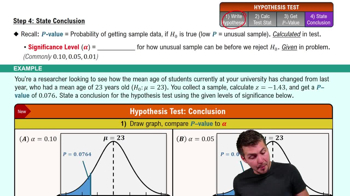
09:56Step 4: State Conclusion
Related Videos
Related Practice
Textbook Question
41
views