
Ch. 6 - Normal Probability Distributions
Triola - Elementary Statistics 14th Edition
Triola14th EditionElementary StatisticsISBN: 9780137366446Not the one you use?Change textbook
Chapter 6, Problem 6.4.11a

Ergonomics. Exercises 9–16 involve applications to ergonomics, as described in the Chapter Problem.


Water Taxi Safety Passengers died when a water taxi sank in Baltimore’s Inner Harbor. Men are typically heavier than women and children, so when loading a water taxi, assume a worst-case scenario in which all passengers are men. Assume that weights of men are normally distributed with a mean of 189 lb and a standard deviation of 39 lb (based on Data Set 1 “Body Data” in Appendix B). The water taxi that sank had a stated capacity of 25 passengers, and the boat was rated for a load limit of 3500 lb.


a. Given that the water taxi that sank was rated for a load limit of 3500 lb, what is the maximum mean weight of the passengers if the boat is filled to the stated capacity of 25 passengers?

Verified step by step guidance
1
Step 1: Understand the problem. The goal is to determine the maximum mean weight of passengers such that the total weight does not exceed the boat's load limit of 3500 lb when the boat is filled to its stated capacity of 25 passengers.
Step 2: Set up the relationship between the total weight, mean weight, and number of passengers. The total weight of the passengers can be expressed as: \( \text{Total Weight} = \text{Mean Weight} \times \text{Number of Passengers} \).
Step 3: Substitute the given values into the equation. The total weight is limited to 3500 lb, and the number of passengers is 25. This gives: \( 3500 = \text{Mean Weight} \times 25 \).
Step 4: Solve for the mean weight. Rearrange the equation to isolate the mean weight: \( \text{Mean Weight} = \frac{3500}{25} \).
Step 5: Interpret the result. The calculated mean weight represents the maximum allowable average weight per passenger to ensure the total weight does not exceed the boat's load limit of 3500 lb.

Verified video answer for a similar problem:

This video solution was recommended by our tutors as helpful for the problem above.
Video duration:
1m
Was this helpful?

Key Concepts

Here are the essential concepts you must grasp in order to answer the question correctly.

Normal Distribution

Normal distribution is a probability distribution that is symmetric about the mean, showing that data near the mean are more frequent in occurrence than data far from the mean. In this context, the weights of men are assumed to follow a normal distribution with a specified mean and standard deviation, which allows for the calculation of probabilities and percentiles related to weight.
Recommended video:
Guided course
09:47
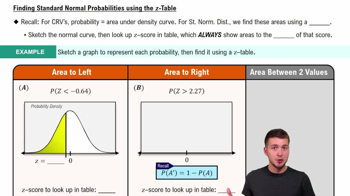
Finding Standard Normal Probabilities using z-Table

Mean Weight Calculation

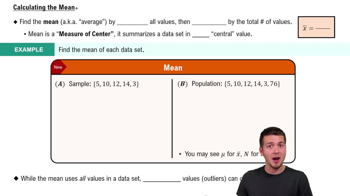
The mean weight is the average weight of a group of individuals, calculated by summing all individual weights and dividing by the number of individuals. In this scenario, to find the maximum mean weight for 25 passengers without exceeding the load limit, one must divide the total load limit (3500 lb) by the number of passengers (25).
Recommended video:
Guided course
04:52
Calculating the Mean

Load Capacity and Safety Regulations

Load capacity refers to the maximum weight a vehicle or structure can safely carry. In the case of the water taxi, understanding the load capacity is crucial for ensuring safety, as exceeding this limit can lead to dangerous situations, such as capsizing. This concept emphasizes the importance of adhering to safety regulations in transportation.
Recommended video:
Guided course
04:40
Calculating Correlation Coefficient - Graphing Calculator
Related Practice
Textbook Question

Fatal Car Crashes There are about 15,000 car crashes each day in the United States, and the proportion of car crashes that are fatal is 0.00559 (based on data from the National Highway Traffic Safety Administration). Assume that each day, 1000 car crashes are randomly selected and the proportion of fatal car crashes is recorded.

a. What do you know about the mean of the sample proportions?

149
views
Textbook Question

Using the Central Limit Theorem. In Exercises 5–8, assume that the amounts of weight that male college students gain during their freshman year are normally distributed with a mean of 1.2 kg and a standard deviation of 4.9 kg (based on Data Set 13 “Freshman 15” in Appendix B).


a. If 1 male college student is randomly selected, find the probability that he gains between 0.5 kg and 2.5 kg during freshman year.

183
views
Textbook Question

Body Temperatures Listed below are body temperatures (°F) of adult males (based on Data Set 5 “Body Temperatures” in Appendix B).


97.6 98.2 99.6 98.7 99.4 98.2 98.0 98.6 98.6


a. Find the mean. Does the result seem reasonable?

130
views
Textbook Question

Curving Test Scores A professor gives a test and the scores are normally distributed with a mean of 60 and a standard deviation of 12. She plans to curve the scores.


a. If she curves by adding 15 to each grade, what is the new mean and standard deviation?

125
views
Textbook Question

Hershey Kisses Based on Data Set 38 “Candies” in Appendix B, weights of the chocolate in Hershey Kisses are normally distributed with a mean of 4.5338 g and a standard deviation of 0.1039 g.


a. What are the values of the mean and standard deviation after converting all weights of Hershey Kisses to z scores using z = (x - μ)/σ ?


b. The original weights are in grams. What are the units of the corresponding z scores?

211
views
Textbook Question

Smartphones Based on an LG smartphone survey, assume that 51% of adults with smartphones use them in theaters. In a separate survey of 250 adults with smartphones, it is found that 109 use them in theaters.


a. If the 51% rate is correct, find the probability of getting 109 or fewer smartphone owners who use them in theaters.

64
views