
In Exercises 49-53, use counting principles to find the probability. 50. A security code consists of three letters and one digit. The first letter cannot be A, B, or C. What is the probability of guessing the security code on the first try?
Verified step by step guidance
1
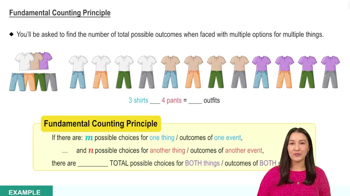
Step 1: Determine the total number of possible outcomes for the security code. The code consists of three letters and one digit. For the first letter, there are 23 choices (since the first letter cannot be A, B, or C, leaving 26 - 3 = 23 letters). For the second and third letters, there are 26 choices each (no restrictions). For the digit, there are 10 choices (0 through 9). Multiply these possibilities together to find the total number of possible codes: 23 × 26 × 26 × 10.
Step 2: Recognize that there is only one correct security code. This means there is only one favorable outcome.
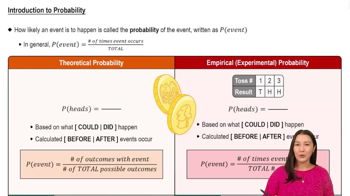
Step 3: Use the formula for probability: \( P = \frac{\text{Number of Favorable Outcomes}}{\text{Total Number of Possible Outcomes}} \). Substitute the values from Step 1 and Step 2 into this formula.
Step 4: Simplify the fraction obtained in Step 3 to express the probability in its simplest form.
Step 5: Interpret the result as the probability of guessing the security code correctly on the first try.
Verified video answer for a similar problem:
This video solution was recommended by our tutors as helpful for the problem above
Video duration:
3m
Play a video:
0 Comments
Key Concepts
Here are the essential concepts you must grasp in order to answer the question correctly.
Counting Principles
Counting principles, such as the multiplication and addition rules, are fundamental in determining the total number of possible outcomes in a scenario. In this case, we need to calculate the total combinations of letters and digits to find the probability of guessing the security code correctly.
Probability is a measure of the likelihood of an event occurring, expressed as a ratio of favorable outcomes to the total number of possible outcomes. To find the probability of guessing the security code, we will divide the number of successful outcomes (correct code) by the total number of possible codes.
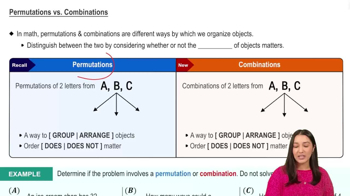
Permutations and combinations are methods used to count arrangements and selections of items. In this problem, we need to consider the restrictions on the first letter and how many choices we have for each position in the security code, which affects the total number of combinations.