
Ch. 3 - Probability
Larson - Elementary Statistics: Picturing the World 8th Edition
Larson8th EditionElementary Statistics: Picturing the WorldISBN: 9780137493470Not the one you use?Change textbook
Chapter 3, Problem 3.R.52b

In Exercises 49-53, use counting principles to find the probability.
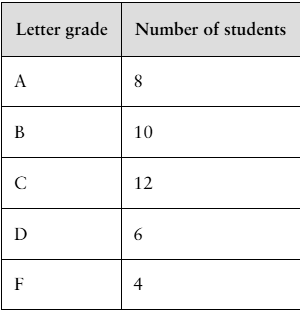
52. A class of 40 students takes a statistics exam. The results are shown in the table at the left. Three students are selected at random. What is the probability that
b. all three students received a C or better?
Table showing letter grades and the number of students: A-8, B-10, C-12, D-6, F-4.

Verified step by step guidance
1
Step 1: Identify the total number of students in the class. From the table, sum the number of students across all letter grades: A (8), B (10), C (12), D (6), and F (4). This gives a total of 40 students.
Step 2: Determine the number of students who received a grade of C or better. From the table, grades A, B, and C are considered 'C or better.' Add the number of students in these categories: A (8), B (10), and C (12). This gives a total of 30 students.
Step 3: Calculate the total number of ways to select 3 students from the class. Use the combination formula \( \binom{n}{r} = \frac{n!}{r!(n-r)!} \), where \( n \) is the total number of students (40) and \( r \) is the number of students to be selected (3).
Step 4: Calculate the number of ways to select 3 students who received a grade of C or better. Again, use the combination formula \( \binom{n}{r} \), where \( n \) is the number of students who received C or better (30) and \( r \) is the number of students to be selected (3).
Step 5: Find the probability that all three selected students received a grade of C or better. Divide the number of favorable outcomes (from Step 4) by the total number of outcomes (from Step 3). The formula for probability is \( P = \frac{\text{favorable outcomes}}{\text{total outcomes}} \).

Verified video answer for a similar problem:

This video solution was recommended by our tutors as helpful for the problem above.
Video duration:
3m
Was this helpful?

Key Concepts

Here are the essential concepts you must grasp in order to answer the question correctly.

Counting Principles

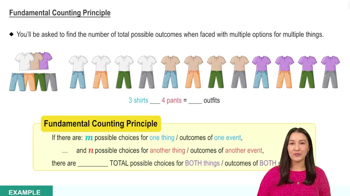
Counting principles, such as the fundamental counting principle, help determine the number of ways to choose or arrange items. In this context, it is essential for calculating the total number of combinations of students that can be selected from the class. Understanding how to apply these principles allows for accurate probability calculations based on the number of favorable outcomes versus total outcomes.
Recommended video:
04:04
Fundamental Counting Principle

Probability

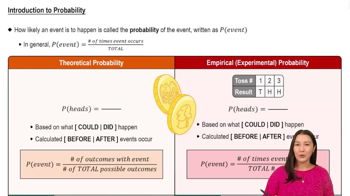
Probability is a measure of the likelihood that a particular event will occur, expressed as a ratio of favorable outcomes to total possible outcomes. In this scenario, the probability of selecting three students who received a C or better involves determining how many students fall into that category and how many ways they can be selected. This concept is fundamental for quantifying uncertainty in statistical analysis.
Recommended video:
5:37
Introduction to Probability

Combinations

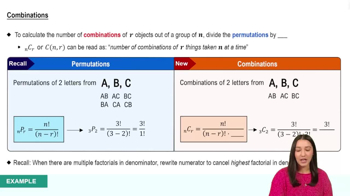
Combinations refer to the selection of items from a larger set where the order does not matter. In this problem, we need to calculate the number of ways to choose three students from those who received a C or better. The combination formula, denoted as nCr, is crucial for determining how many different groups of students can be formed, which directly impacts the probability calculation.
Recommended video:
05:22
Combinations
Related Practice
Textbook Question

In Exercises 17 and 18, use the table, which shows the numbers of first-time and repeat U.S. nursing students taking the National Council Licensure Examination (NCLEX-RN® exam) to pass or fail in a recent year. (Adapted from National Council Licensure Examinations)

17. Find the probability that a student took the exam for the first time, given that the student failed.

58
views
Textbook Question

In Exercises 45-48, use combinations and permutations.

46. Five players on a basketball team must each choose one of the five players on the opposing team to defend. In how many ways can the players choose their defensive assignments?

100
views
Textbook Question

"In Exercises 5 and 6, use the Fundamental Counting Principle.

5. A student must choose from seven classes to take at 8:00 A.M., four classes to take at 9:00 A.M., and three classes to take at 10:00 A.M. How many ways can the student arrange the schedule?"

53
views
Textbook Question

"In Exercises 1-4, identify the sample space of the probability experiment and determine the number of outcomes in the event. Draw a tree diagram when appropriate.

1. Experiment: Tossing four coins

Event: Getting three heads"

92
views
Textbook Question

In Exercises 49-53, use counting principles to find the probability.

50. A security code consists of three letters and one digit. The first letter cannot be A, B, or C. What is the probability of guessing the security code on the first try?

87
views
Textbook Question

In Exercises 49-53, use counting principles to find the probability.

52. A class of 40 students takes a statistics exam. The results are shown in the table at the left. Three students are selected at random. What is the probability that

d. all three students received a B or a C?

66
views