
56. Defective Disks A pack of 100 recordable DVDs contains 5 defective disks. You select four disks. What is the probability of selecting at least three non defective disks?
Table of contents
- 1. Intro to Stats and Collecting Data1h 14m
- 2. Describing Data with Tables and Graphs1h 55m
- 3. Describing Data Numerically2h 5m
- 4. Probability2h 16m
- 5. Binomial Distribution & Discrete Random Variables3h 6m
- 6. Normal Distribution and Continuous Random Variables2h 11m
- 7. Sampling Distributions & Confidence Intervals: Mean3h 23m
- Sampling Distribution of the Sample Mean and Central Limit Theorem19m
- Distribution of Sample Mean - Excel23m
- Introduction to Confidence Intervals15m
- Confidence Intervals for Population Mean1h 18m
- Determining the Minimum Sample Size Required12m
- Finding Probabilities and T Critical Values - Excel28m
- Confidence Intervals for Population Means - Excel25m
- 8. Sampling Distributions & Confidence Intervals: Proportion1h 25m
- 9. Hypothesis Testing for One Sample3h 29m
- 10. Hypothesis Testing for Two Samples4h 50m
- Two Proportions1h 13m
- Two Proportions Hypothesis Test - Excel28m
- Two Means - Unknown, Unequal Variance1h 3m
- Two Means - Unknown Variances Hypothesis Test - Excel12m
- Two Means - Unknown, Equal Variance15m
- Two Means - Unknown, Equal Variances Hypothesis Test - Excel9m
- Two Means - Known Variance12m
- Two Means - Sigma Known Hypothesis Test - Excel21m
- Two Means - Matched Pairs (Dependent Samples)42m
- Matched Pairs Hypothesis Test - Excel12m
- 11. Correlation1h 24m
- 12. Regression1h 50m
- 13. Chi-Square Tests & Goodness of Fit2h 21m
- 14. ANOVA1h 57m
4. Probability
Counting
Problem 3.R.46
Textbook Question
In Exercises 45-48, use combinations and permutations.
46. Five players on a basketball team must each choose one of the five players on the opposing team to defend. In how many ways can the players choose their defensive assignments?
Verified step by step guidance1
Step 1: Recognize that this is a permutations problem because the order in which the defensive assignments are made matters. Each player on the basketball team is assigned to defend a specific player on the opposing team.
Step 2: Recall the formula for permutations, which is used when the order of selection matters. The formula is P(n, r) = n! / (n - r)!, where n is the total number of items to choose from, and r is the number of items being chosen.
Step 3: In this problem, there are 5 players on the basketball team and 5 players on the opposing team. Since all 5 players are being assigned, n = 5 and r = 5. Substitute these values into the permutation formula: P(5, 5) = 5! / (5 - 5)!.
Step 4: Simplify the expression. The factorial of 5 (5!) is calculated as 5 × 4 × 3 × 2 × 1. The factorial of 0 (0!) is defined as 1. Therefore, P(5, 5) = 5! / 1.
Step 5: Conclude that the total number of ways the players can choose their defensive assignments is equal to the value of 5!. This represents the number of permutations of 5 players.
Verified video answer for a similar problem:This video solution was recommended by our tutors as helpful for the problem above
Video duration:
1mPlay a video:
Was this helpful?
Key Concepts
Here are the essential concepts you must grasp in order to answer the question correctly.
Permutations
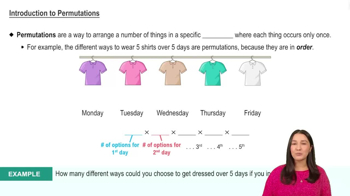
Permutations refer to the different arrangements of a set of items where the order matters. In the context of the basketball question, each player choosing a defender from the opposing team represents a unique arrangement, as the specific choice of defender by each player affects the overall assignment.
Recommended video:
Introduction to Permutations
Combinations
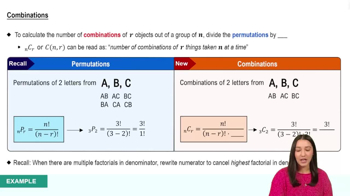
Combinations involve selecting items from a larger set where the order does not matter. While the basketball scenario primarily deals with permutations, understanding combinations is essential for grasping how selections can be made without regard to the order of choices, which can be relevant in different contexts.
Recommended video:
Combinations
Factorial
Factorial, denoted as n!, is the product of all positive integers up to n. It is a fundamental concept in counting arrangements and is used to calculate the total number of ways to arrange or select items. In the basketball problem, factorials help determine the total number of unique defensive assignments based on the players' choices.
Recommended video:
Combinations
Watch next
Master Introduction to Permutations with a bite sized video explanation from Patrick
Start learningRelated Videos
Related Practice
Textbook Question
38
views
